

Chronic ear problems are often seen as childhood issues, but many adults in Melbourne and across Victoria live with ongoing ear fullness, muffled hearing or repeated infections. Symptoms can creep in gradually and become part of everyday life, even though they may affect work, social interactions and overall wellbeing.
Grommets, also called ventilation tubes or ear tubes, are a small surgical option that can help selected adults with long term ear problems linked to fluid or pressure behind the eardrum. They are not suitable for every ear condition, but in the right situation they can make a meaningful difference to hearing and comfort.
At Melbourne ENT in St Kilda East, adults and children with persistent ear symptoms can be assessed by Dr Simon Braham, Ear, Nose and Throat (ENT) and Head & Neck Surgeon. He provides careful diagnosis and tailored advice so that each person understands what is causing their symptoms and which treatments are most appropriate for their circumstances.
This article explains how the adult ear works, which chronic ear conditions may benefit from grommets, what the procedure involves, how Medicare may apply and how Melbourne ENT supports patients before and after treatment. It is general information only and does not replace a consultation with your GP or specialist.
How The Adult Ear Works and Where Grommets Fit In
✓ The Middle Ear and Eustachian Tube
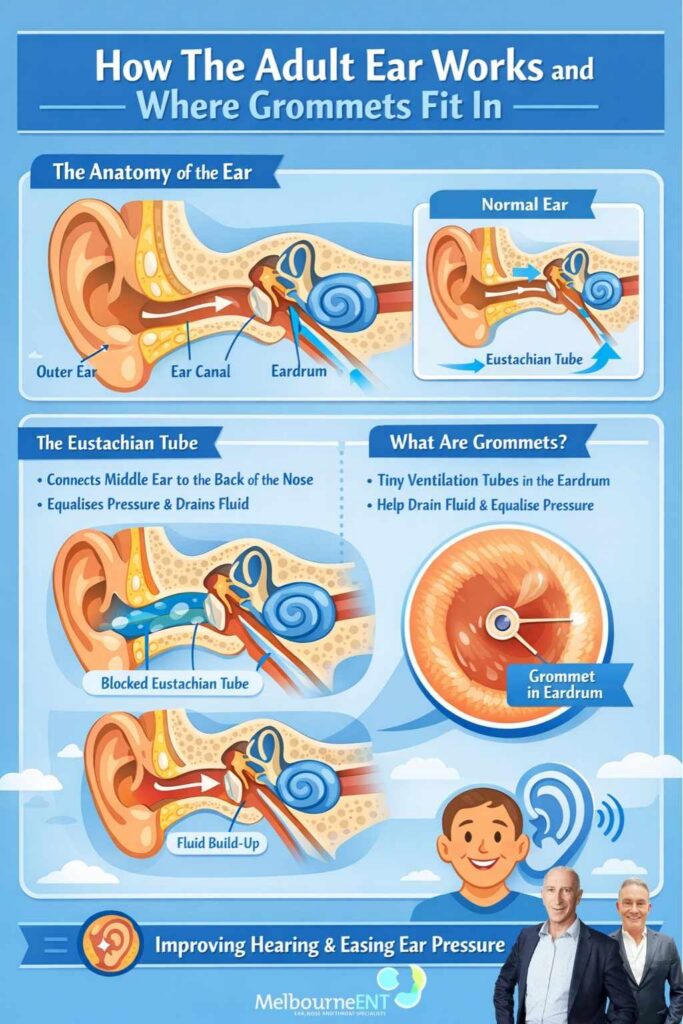
The ear has three main parts. The outer ear includes the visible ear and the ear canal, which carries sound towards the eardrum. The eardrum is a thin membrane that vibrates in response to sound waves. Just behind the eardrum is the middle ear, a small air filled space that contains three tiny bones which pass sound vibrations on to the inner ear.
The middle ear is connected to the back of the nose by a narrow passage called the Eustachian tube. This tube opens briefly when you swallow, yawn or chew. Its role is to equalise air pressure on both sides of the eardrum and to allow small amounts of fluid produced in the middle ear to drain away.
When the Eustachian tube is working well, the middle ear stays filled with air and the eardrum moves freely. When it does not work properly, the pressure in the middle ear can drop and fluid can build up. Over time this may cause muffled hearing, a blocked or full sensation, crackling noises and a higher risk of infections.
✓ What Are Grommets (Ventilation Tubes)
Grommets are tiny hollow tubes that sit in a small opening in the eardrum. They are usually made of plastic or similar material and are designed to stay in place for several months or longer, depending on the type used. Their central hole allows air to move between the ear canal and the middle ear.
By providing this small ventilation pathway, grommets can help equalise pressure in the middle ear and allow trapped fluid to drain out. In adults whose symptoms are caused by persistent fluid or pressure problems, this can improve hearing and reduce discomfort. Over time, the grommet usually works its way out of the eardrum and falls into the ear canal, and the eardrum then heals.
At Melbourne ENT, grommets are viewed as one part of a broader management plan. They are usually considered after careful assessment and after other options, such as nasal treatment and watchful waiting, have been tried or discussed.
Chronic Ear Problems in Adults – Not Just a Childhood Issue
✓ Why Adults Develop Chronic Ear Problems
Adults can develop chronic ear problems for many different reasons. Some have a history of childhood ear disease and carry a tendency to middle ear problems into adult life. Others develop new symptoms due to changes in their nose or sinuses, environmental exposures or lifestyle factors.
Allergies and chronic sinus conditions can cause swelling around the opening of the Eustachian tube at the back of the nose. Structural issues such as a deviated septum may alter airflow and contribute to congestion. Smoking and exposure to dust, fumes or other irritants can affect the lining of the nose and Eustachian tube and reduce its ability to open and close.
Repeated colds or upper respiratory infections may trigger cycles of inflammation and fluid build up behind the eardrum. Some adults work in roles that involve frequent flying or pressure changes, such as regular interstate or international travel from Melbourne, which can strain the Eustachian tube. Previous head and neck surgery or radiotherapy can also influence the way the Eustachian tube works.
✓ Why Adults Often Delay Seeking Care
Many adults adapt to gradual changes in hearing or ear comfort. Turning up the television, asking people to repeat themselves or avoiding noisy venues can feel easier than arranging medical appointments. Busy work schedules, family responsibilities and the perception that ear problems are mainly a childhood issue can all contribute to delays in seeking help.
Over time, however, chronic ear problems can make conversations tiring, reduce confidence in social situations and affect performance at work. Ear pain, fullness or infections can interfere with sleep and general health. When symptoms persist for more than a few weeks, keep recurring or affect daily activities, it is appropriate to talk with a GP and consider referral to an ENT specialist such as Dr Simon Braham at Melbourne ENT.
Adult Ear Conditions That May Benefit From Grommets
✓ Persistent Middle Ear Fluid (Adult Glue Ear / Otitis Media With Effusion)
Persistent fluid behind the eardrum, known as otitis media with effusion or glue ear, is a common reason for considering grommets surgery in Melbourne. Instead of air filling the middle ear, thick or sticky fluid accumulates and restricts the movement of the eardrum and the tiny bones. Hearing becomes less clear, especially in background noise.
Adults with glue ear often describe hearing that feels dull or as though they are under water. One ear may feel blocked or heavy. Voices can sound distant and fine details in music or speech may be hard to pick up. The difference between the two ears can make localisation of sounds more difficult.
In many cases, glue ear following an infection improves over time, especially when nasal and sinus symptoms are treated. When fluid persists for months despite conservative care and is confirmed on examination and hearing tests, ventilation tubes may be recommended. By ventilating the middle ear space, a grommet can restore air where there was fluid and often leads to clearer hearing. In adults, it is important to investigate persistent or one sided fluid to look for underlying causes before proceeding.
✓ Recurrent Middle Ear Infections
Recurrent middle ear infections are another situation where grommets may be helpful. Adults with this problem experience repeated episodes of ear pain, temporary hearing loss and sometimes discharge if the eardrum perforates. Each episode may follow a cold or appear seemingly out of the blue.
Repeated infections can lead to frequent GP visits, antibiotic courses and time off work. Sleep may be disturbed and there may be ongoing worry about when the next infection will occur. For some adults, infections settle in between episodes and the ears feel normal at times. For others, there is lingering fluid or a constant feeling of fullness.
By providing a ventilation route through the eardrum, grommets can reduce the build up of fluid and pressure that often precedes infection. This can reduce the frequency or severity of infections in carefully selected adults. At Melbourne ENT, Dr Simon Braham will look at how often infections occur, how severe they are and whether there is underlying fluid or anatomical change before suggesting grommets surgery.
✓ Eustachian Tube Dysfunction and Pressure Problems
Eustachian tube dysfunction occurs when the tube does not open properly or stays blocked. Adults may notice intermittent popping, crackling, a blocked effect or discomfort during changes in altitude. Flights in and out of Melbourne, trips to higher areas in Victoria or even elevator rides in tall buildings can trigger unpleasant sensations in the ears.
Some people can clear their ears with swallowing or performing gentle pressure equalisation techniques. Others find that their ears never feel properly open. Weather changes, allergies and nasal congestion can all make symptoms worse. Over time, there may be more persistent fullness and hearing fluctuation.
In mild cases, nasal sprays, saline rinses, allergy management and simple self care measures are often enough. When symptoms are severe, frequent, or accompanied by evidence of middle ear fluid or marked pressure abnormalities on tests, grommets may be considered as part of the treatment plan. For frequent flyers and divers, Melbourne ENT will discuss how grommets could affect these activities and will tailor advice to each person.
✓ Eardrum Retraction and Retraction Pockets
If negative pressure in the middle ear continues over a long period, the eardrum can be pulled inward. This is known as eardrum retraction. In some areas the eardrum may thin and form pockets that extend into the middle ear and collect skin and debris.
Early on, retraction may cause few symptoms apart from subtle changes in hearing. As it progresses, it can affect the tiny bones of hearing and increase the risk of more serious middle ear disease. Experienced ENT assessment is important to monitor retraction and decide when intervention is needed.
Grommets can help by improving middle ear ventilation and reducing the negative pressure that pulls the eardrum inward. In selected adults, this may allow the eardrum to sit in a healthier position and reduce the risk of further damage. In more advanced cases, grommets may be combined with other ear surgery. Dr Simon Braham at Melbourne ENT will examine the eardrum under magnification and use hearing test results to guide these decisions.
✓ Ear Conditions Where Grommets Are Unlikely to Help
Some chronic ear symptoms arise from the inner ear or hearing nerve rather than the middle ear. Age related hearing loss, many forms of tinnitus and many balance disorders fall into this category. In these situations, grommets are unlikely to help because the underlying problem is not related to fluid or pressure behind the eardrum.
Accurate diagnosis is therefore essential before surgery is considered. At Melbourne ENT, assessment aims to distinguish between middle ear problems that may respond to grommets and inner ear conditions that require other approaches, such as hearing aids, vestibular rehabilitation or further investigation.
Assessment Pathway For Adults at Melbourne ENT
Starting With Your GP
For most adults, the pathway begins with their general practitioner. Your GP can listen to your concerns, examine your ears and arrange initial investigations such as a hearing test. If symptoms are mild and recent, they may suggest simple treatments and review.
If symptoms persist, affect daily life or raise any concern about the underlying cause, your GP can provide a referral to an ENT specialist. This referral is important for coordinated care and for accessing Medicare rebates on specialist consultations and eligible procedures. Bringing a clear description of your symptoms, including how long they have been present and any triggers you have noticed, can help your GP and your ENT specialist understand the pattern.
Specialist Assessment with Dr Simon Braham
At Melbourne ENT in St Kilda East, specialist assessment is carried out by Dr Simon Braham, ENT and Head & Neck Surgeon. The appointment begins with a detailed discussion of your symptoms, ear history, general health and lifestyle. This may include questions about childhood ear problems, allergies, sinus symptoms, previous surgery and your work and travel patterns.
A careful examination of the ears follows, usually with a microscope to provide a clear view of the eardrum and ear canal. The nose and throat are often examined as well, since problems in these areas can affect the Eustachian tube and middle ear. In some cases, a small flexible camera may be used to examine the back of the nose.
Hearing tests play a key role in assessment. An audiogram measures how well you hear different pitches and volumes. Tympanometry assesses the movement of the eardrum with pressure changes and helps detect fluid or stiffness in the middle ear system. Taken together, these findings allow Dr Braham to determine whether chronic ear infections are likely to respond to grommets or whether another approach is needed.
When Further Investigations May Be Needed
In some adults, further investigation is recommended. This is more likely when fluid is present in only one ear, when symptoms appear suddenly without an obvious cause or when examination raises any concern about the structures around the Eustachian tube. Additional tests might include more detailed nasal and nasopharyngeal examination or imaging studies.
Dr Simon Braham has extensive experience in managing complex ear and head and neck conditions, including work in major Victorian hospitals such as the Royal Melbourne Hospital and the Royal Victorian Eye and Ear Hospital. This background supports a thorough yet targeted approach to choosing investigations, so that significant conditions are not missed but unnecessary tests are avoided.
Treatment Options – Stepwise Care Before And Alongside Grommets
✓ Watchful Waiting and Monitoring
Not all chronic ear problems require immediate intervention. In many cases, particularly when symptoms follow a recent infection, time and monitoring are appropriate. Watchful waiting means allowing a period for natural recovery while keeping an eye on symptoms and hearing.
During this stage, you may have follow up visits and repeat hearing tests at Melbourne ENT to document whether things are improving, stable or worsening. You will also receive clear advice about what to look out for and when to seek earlier review. This structured approach allows many adults to avoid surgery when their condition is likely to settle on its own.
✓ Medical and Conservative Management
Medical and conservative treatments are often used before grommets are considered. Nasal steroid sprays and saline rinses can reduce swelling in the nose and around the Eustachian tube opening. Allergy management can help those with hay fever or other allergic conditions. Simple measures such as avoiding smoking and minimising exposure to irritants can also be valuable.
Some adults benefit from autoinflation techniques or other pressure equalisation exercises taught under guidance. Pain relief, rest and good general health care are also important during infections. Where appropriate, your GP and Dr Braham will coordinate these measures to give the middle ear the best chance to recover without surgery.
✓ When Surgery May Be Discussed
Surgery comes into the picture when symptoms are persistent, significantly affect quality of life and are clearly linked to middle ear fluid or pressure problems. At this point, Dr Simon Braham will explain the findings in detail and outline the potential role of grommets.
The discussion includes likely benefits, possible risks, alternative options and what would happen if you choose not to have surgery. Every adult has different priorities, so the final decision is made together, taking into account your work, family responsibilities, health status and personal preferences. Melbourne ENT aims to ensure that if surgery is chosen, it is for a clear and well understood reason.
Grommet Surgery For Adults – Expectations and Medicare
✓ Where and How the Procedure is Performed
Grommet insertion in adults is usually performed as a short day surgery procedure in an accredited hospital in Melbourne. You arrive on the day of surgery, are admitted, have the procedure and then return home once you have recovered from the anaesthetic and are medically stable.
Most adults have a brief general anaesthetic, which allows the surgeon to work with precision in the very small space of the ear canal and eardrum. While you are asleep, the ear canal is cleaned and the eardrum is carefully examined. A tiny incision is made in the eardrum, any fluid in the middle ear is gently removed and the grommet is placed into the opening so its central channel allows ventilation.
After the procedure, you are moved to the recovery area. As you wake, nursing staff monitor your breathing, blood pressure and comfort levels. Once you are fully awake and able to drink and walk safely, you are discharged with instructions and a follow up appointment at Melbourne ENT.
✓ Medicare Coverage and Private Health Considerations
In Australia, grommet insertion for chronic middle ear problems is a recognised procedure with Medicare item numbers when performed by a specialist ENT surgeon. If you have a current referral from your GP or another specialist, part of the surgeon’s fee is usually rebated by Medicare. Consultation fees before and after surgery may also attract Medicare rebates.
If you have private hospital cover that includes ENT or ear surgery, your health fund may contribute to hospital theatre and accommodation charges and may cover some or all of the surgeon and anaesthetist fees, depending on your policy and any excess. For patients without private hospital cover, Medicare may still provide a rebate, but there will usually be additional out of pocket costs.
Before you decide on surgery, the team at Melbourne ENT can provide a written estimate that outlines likely fees, Medicare rebates and any expected gap. They can also help you understand which questions to ask your health fund. This allows you to plan ahead and make an informed decision about proceeding with grommet surgery.
✓ Recovery, Follow Up and Daily Activities
Recovery after grommet surgery is usually swift. Many adults feel well enough to resume light activities within a day or two, although it is common to feel a little tired from the anaesthetic. The ear may feel different for a short time and sounds may seem louder or sharper, especially if fluid had been present for some time.
You will have follow up appointments at Melbourne ENT so that Dr Simon Braham can check the position of the grommet, review healing and assess changes in hearing. Any concerns, such as mild discharge or discomfort, can be addressed promptly at these visits.
You will receive individual advice about work, exercise, flying and swimming. Most office based work can be resumed quickly. Some adults may be advised to avoid deep diving or to use ear protection in certain water activities. Over time, the grommet usually falls out of the eardrum on its own, and the eardrum heals. If symptoms return, further assessment will help decide whether another grommet or a different treatment is appropriate.
Potential Benefits of Grommets in Adults With Chronic Ear Problems
✓ Symptom and Hearing Changes
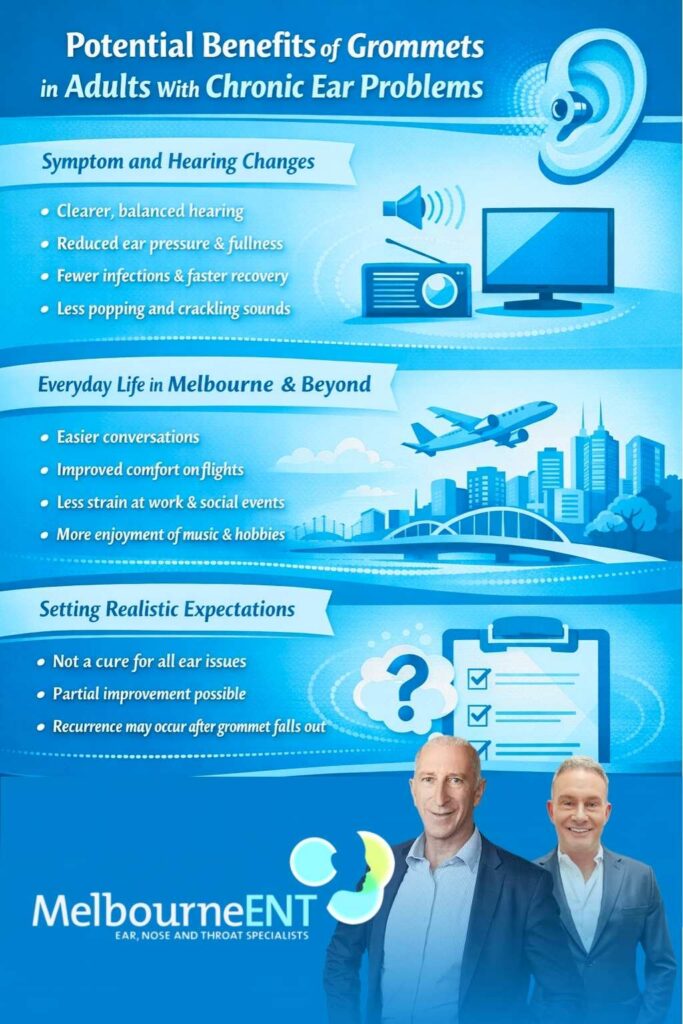
For adults whose chronic ear problems are mainly due to middle ear fluid or pressure, grommets can bring meaningful improvements. Hearing often becomes clearer and more balanced, making conversation easier to follow. Many people notice they can turn the television or radio down and still hear comfortably.
The feeling of fullness or pressure in the ear may ease, and popping or crackling sounds may reduce. For those with recurrent infections, there may be fewer episodes, less intense pain and quicker recovery times. These benefits are individual, but they are the main reasons grommets are offered when conservative care has not been enough.
✓ Everyday Life in Melbourne and Beyond
Improving ear function often has a ripple effect across daily life. Work meetings, phone calls and social events in Melbourne’s busy environments can become less tiring when you are not constantly straining to hear. Being able to follow conversations more easily can reduce frustration and improve confidence.
For frequent flyers, flights to and from Melbourne, interstate and overseas may become more comfortable, with less severe ear pain from pressure changes. Leisure activities, family time and simple pleasures such as listening to music or engaging in hobbies can also be more enjoyable when chronic ear symptoms are better controlled.
✓ Setting Realistic Expectations
Although grommets surgery Melbourne can be very helpful in selected adults, they are not a cure for every ear problem. They are most effective when chronic symptoms are clearly linked to middle ear fluid or pressure rather than inner ear causes. Some adults may experience partial improvement rather than complete resolution of symptoms.
There is also a chance that problems may recur after the grommet (ear tubes) has fallen out and the eardrum has healed. If this happens, further assessment is needed to decide whether another grommet is likely to help or whether an alternative approach should be considered. At Melbourne ENT, these possibilities are discussed before surgery so that expectations are realistic and informed.
Risks, Limitations and Longer Term Considerations
✓ Risks Associated With Grommet Insertion
Grommet insertion surgery is generally a safe and straightforward procedure, but all surgery carries some risk. Ear discharge or infection can occur in some patients after grommets are placed. This is usually managed with ear drops and follow up care and rarely leads to serious problems.
There is a small risk that a perforation in the eardrum will remain after the grommet falls out, rather than closing naturally. If this causes symptoms or affects hearing, further surgery to repair the eardrum may be recommended. Scarring on the eardrum can also develop, although this usually does not cause significant hearing loss.
There are also general risks associated with anaesthesia, which are low in most healthy adults but must always be considered. Before surgery, your medical history and medications are reviewed and you will have the chance to ask questions about these risks.
✓ Limitations of Grommets in Adults
Grommets are designed to treat problems in the middle ear, not the inner ear or hearing nerve. They do not reverse age related hearing loss and they do not treat all causes of tinnitus or dizziness. Some adults may continue to require hearing aids or other treatments even after successful grommet insertion.
It is also possible that grommets may need to be repeated if the underlying tendency to fluid or Eustachian tube dysfunction persists. Not everyone is suited to multiple procedures, so careful consideration is given to the overall pattern of disease and the full range of available options.
✓ Alternative or Additional Treatments
For some adults, alternative treatments such as hearing aids, other forms of ear surgery or procedures directed at the Eustachian tube may be more suitable than grommets. Others may benefit from a combination of a grommet and another treatment. Decisions depend on the exact diagnosis, anatomy, severity of symptoms and overall health.
At Melbourne ENT, treatment planning is individualised. Dr Simon Braham will explain why one approach is preferred over another and will discuss what can be expected from each option. The aim is to choose a strategy that supports long term ear health and hearing, rather than focusing on a single procedure in isolation.
Living With Chronic Ear Problems – Practical Tips For Adults
✓ Self Care and Symptom Management
While you are being assessed or waiting for the full effect of treatment, there are several practical steps you can take to manage chronic ear symptoms. Using nasal sprays as prescribed, performing saline rinses correctly and taking allergy medications as advised can all help support better Eustachian tube function.
Maintaining good general health, staying hydrated and avoiding smoking or passive smoke can also be helpful. When you have a cold, treating nasal congestion early and resting appropriately may reduce the impact on your ears. Gentle pressure equalisation techniques can be useful during flights or altitude changes, as long as they are done carefully.
Keeping a brief record of your symptoms, including when they are better or worse, may provide useful information for your GP and for Dr Simon Braham at Melbourne ENT. This can help identify triggers and patterns that might otherwise be missed.
✓ When to Seek Prompt Medical Attention
Some ear symptoms need urgent review. Sudden hearing loss, especially if it affects only one ear, is considered an emergency and should be assessed as soon as possible. Severe ear pain, significant dizziness, persistent discharge, fever or neurological symptoms such as facial weakness also warrant urgent medical attention.
If you have diabetes, immune system problems or a history of significant ear surgery, it is particularly important not to ignore new or worsening ear symptoms. In these situations, prompt assessment by your GP or direct specialist review can reduce the risk of complications and protect your long term hearing.

FAQs About Chronic Ear Problems in Adults and Grommets
Can chronic ear problems affect my concentration or fatigue levels even if my hearing test is close to normal?
Yes. Even mild or fluctuating hearing changes can make listening much more effortful, especially in busy environments such as open plan offices or social gatherings. Your brain has to work harder to fill in gaps, lip read and guess context. Over time this extra effort can contribute to fatigue, headaches and difficulty concentrating, even when standard hearing tests look almost normal. Part of the assessment at Melbourne ENT is to explore how your symptoms affect day to day life, not just what appears on the audiogram.
If my ear symptoms come and go, how do you decide whether grommets are a good idea?
Many adults notice good days and bad days rather than constant symptoms. Dr Simon Braham will look at your overall pattern over weeks and months, not just how you feel on the day of the appointment. He will consider how often symptoms interfere with work, sleep or travel, as well as what the examination and tests show. Grommets are more likely to be suggested if there is clear evidence of ongoing fluid or pressure problems that match your symptom pattern, rather than occasional mild issues that settle quickly on their own.
Will having grommets change the way my own voice sounds to me?
Some adults notice that their own voice sounds different after grommets, especially if they had significant middle ear fluid beforehand. Your voice may initially seem louder, sharper or more echoing because sound vibrations travel differently when the middle ear is filled with air instead of fluid. This usually settles as you adjust to the new way of hearing. If any ongoing change worries you, it can be discussed at follow up visits at Melbourne ENT.
Can flying or altitude changes still bother my ears after grommets are inserted?
Grommets often make flying more comfortable for people whose main problem was pressure build up behind the eardrum. However, they do not completely remove all sensations of pressure or popping for everyone. Some people still notice mild changes but find that these are far less painful or distressing than before. Dr Simon Braham will talk with you about your travel habits, explain realistic expectations and provide advice on how to manage flights and trips through higher altitude areas in Victoria once grommets are in place.
What happens if my ear feels blocked again after the grommet has fallen out?
Grommets are designed to be temporary. Once they fall out and the eardrum heals, your ears return to relying on the Eustachian tube again. In some adults the underlying problem has improved and symptoms do not return. In others, fullness or muffled hearing may come back over time. If this happens, a repeat assessment at Melbourne ENT can help determine whether another grommet, a different procedure or a non surgical option such as further nasal treatment or hearing support is more appropriate at that stage.
Is it possible to have one ear treated with a grommet and leave the other ear alone?
Yes. Many adults have symptoms or fluid mainly in one ear. In those situations it is quite common to insert a grommet in only the affected side. The decision is based on how each ear looks, how each side performs on hearing tests and how your symptoms are experienced each day. Treating just one ear can still provide significant relief when that side is the main source of fullness, infections or hearing imbalance.
If I already use a hearing aid, can a grommet still be helpful for my chronic ear problems?
It can be, in selected situations. Some adults have a mixed pattern of hearing loss, where part of the problem is due to fluid or middle ear stiffness and part is due to inner ear changes. In those cases, a grommet may improve the middle ear component, while the hearing aid continues to support inner ear hearing loss. This can sometimes make sounds clearer or allow the hearing aid to work more effectively. At Melbourne ENT, Dr Simon Braham will review your existing hearing test results, your hearing aid settings and your middle ear status to decide whether a grommet is likely to add meaningful benefit.
Medical References
- Ventilation tubes (grommets) for otitis media with effusion (OME) in children / Cochrane Database Syst Rev – PubMed / https://pubmed.ncbi.nlm.nih.gov/37965944/
- Grommets (ventilation tubes) for recurrent acute otitis media in children / Cochrane Database Syst Rev – PubMed / https://pubmed.ncbi.nlm.nih.gov/29741289/
- Reimagining grommet follow-up: audiology-led cost comparison / PMC – National Library of Medicine / https://pmc.ncbi.nlm.nih.gov/articles/PMC12584533/
- Ventilation tubes (grommets) for hearing loss associated with otitis media with effusion in children / Nuffield Department of Surgical Sciences – University of Oxford / https://www.nds.ox.ac.uk/publications/611504
- Ventilation tubes (grommets) for otitis media with effusion (OME) in children / PMC – National Library of Medicine / https://pmc.ncbi.nlm.nih.gov/articles/PMC8992697/
- Ventilation tubes (grommets) for otitis media with effusion (OME or ‘glue ear’) in children / Cochrane Library / https://www.cochrane.org/evidence/CD015215_ventilation-tubes-grommets-otitis-media-effusion-ome-or-glue-ear-children
- Grommets (ventilation tubes) for recurrent acute otitis media in children / PMC – National Library of Medicine / https://pmc.ncbi.nlm.nih.gov/articles/PMC6494623/
Next Steps for Adults in Melbourne With Ongoing Ear Symptoms
Talking With Your GP
If you are experiencing persistent ear fullness, muffled hearing, repeated infections or troublesome pressure changes, it is reasonable to arrange a visit with your GP. Explaining how long symptoms have been present, which situations make them better or worse and how they affect your work, sleep and social life can help your doctor understand the impact.
Your GP can examine your ears, arrange hearing tests and consider other possible causes. If chronic middle ear problems are suspected, your GP can provide a referral to an ENT specialist such as Dr Simon Braham at Melbourne ENT. This referral allows coordinated care and access to Medicare rebates for specialist consultations and eligible procedures.
How Melbourne ENT Can Help
Melbourne ENT in St Kilda East provides comprehensive assessment and management for adults and children with ear, nose and throat conditions. For chronic ear problems in adults that may benefit from grommets, the focus is on careful diagnosis, stepwise treatment and clear, practical explanations.
During your consultation, you will have the opportunity to discuss your concerns, learn about the findings and consider the full range of treatment options, including conservative care, grommets and any alternative procedures that may apply in your situation. If surgery is recommended, the team will guide you through hospital arrangements, Medicare rebates and any private health considerations, and provide support during recovery and follow up.
Taking The Next Step
If chronic ear symptoms are affecting your daily life in Melbourne or elsewhere in Victoria, you do not have to manage them alone. Speak with your GP about your concerns and ask whether a referral to Dr Simon Braham at Melbourne ENT may be appropriate.
To learn more about grommet surgery, chronic ear conditions and other services offered at Melbourne ENT, you can contact the practice team or using our contact page.
Further Reading
- Read more about Middle Ear Infection (AOM)
- Read more about Otoplasty Melbourne – Ear Surgery
- Read Melbourne ENT’s Blog on Middle Ear Aeration Methods: How Can They Help?
- Read Melbourne ENT’s Blog on How to Use Hydrogen Peroxide Ear Drops
- Read Melbourne ENT’s Blog on Do you have Ear Pain when Flying? – Effects of Barotrauma
- Read Melbourne ENT’s Blog on What is Otitis Externa? (Swimmer’s Ear)
Chronic Ear Problems in Adults: When Grommet Surgery May Be Considered
Chronic ear problems are often seen as childhood issues, but many adults in Melbourne and…
Can My Child Swim or Bathe With Grommets?
When a child needs grommets Melbourne, many parents feel relieved that something is being done…
Why Ear Infections Spike In Summer And How To Prevent Swimmer’s Ear
Summer in Melbourne usually means warm evenings at St Kilda Beach, endless laps at local…