

Leading Ear, Nose, and Throat (ENT) surgeons Dr Simon Braham and Dr Stephen Kleid offer various treatments for throat concerns, problems and disorders in Melbourne, Australia. Their experience encompasses a wide array of both surgical and non-surgical treatments for issues involving swallowing, breathing, voice and the Throat and Larynx.

At Melbourne ENT, based in St Kilda East, Victoria, we are dedicated to providing expert diagnosis and treatment for a wide range of throat-related conditions. Whether you are suffering from a persistent sore throat, struggling with voice changes, dealing with breathing disturbances at night, or concerned about a throat lesion, our team is here to help.
Under the care of Dr Stephen Kleid and Dr Simon Braham, both highly experienced ENT and Head and Neck Surgeons, patients receive high-quality care tailored to their individual needs. Melbourne ENT combines advanced technology with compassionate service, ensuring a safe, efficient, and patient-focused experience at every stage of your care journey.
Throat Concerns and Conditions We Treat
- Sleep Disturbance
- Sleep Disturbed Breathing for Kids
- Breathing Problems for Adults
- Breathing Problems for Kids
- Snoring Issues
- Tonsillitis
- Throat Conditions
- Obstructive Sleep Apnoea (OSA)
- Voice and Larynx Disorders
- Swallowing issues – Dysphagia
- Tonsil Stones (Tonsilloliths)
- Vocal Hygiene
What Are Throat Conditions?
Throat conditions refer to a group of disorders that affect the pharynx, larynx, tonsils, or nearby tissues in the head and neck. These anatomical areas play essential roles in speaking, breathing, swallowing, and protecting the airway from foreign substances. When affected by illness or abnormal function, they can cause a significant impact on your quality of life.
Throat issues can result from infections, inflammation, reflux, vocal strain, anatomical obstruction, or in more serious cases, cancer. Some conditions arise quickly and resolve with rest and treatment, while others persist or worsen without intervention. A sore throat that does not improve, a voice that suddenly changes and does not return to normal, or breathing difficulty while sleeping may signal the need for evaluation. At Melbourne ENT, we approach throat symptoms with precision and care, ensuring that the cause is correctly identified and managed effectively.
Common Symptoms of Throat Conditions
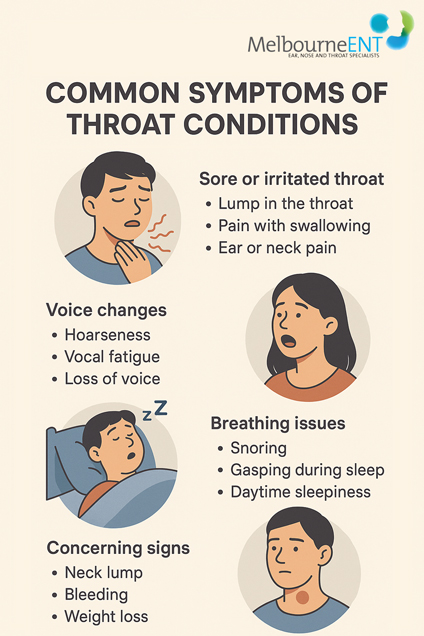
The symptoms associated with throat conditions vary widely depending on the underlying cause, and often multiple symptoms overlap. Commonly, patients notice a sore or irritated throat that lingers beyond what is typical for a cold or flu. Some feel a persistent lump in the throat or difficulty swallowing solids or liquids. Pain may radiate to the ears or neck, particularly during meals or talking.
Voice symptoms can also develop. These include hoarseness, vocal fatigue, reduced pitch control, or complete voice loss. Teachers, singers, and others who rely heavily on their voice may find these symptoms especially distressing.
Many throat conditions also affect breathing. Snoring, gasping for air during sleep, and daytime sleepiness are typical signs of obstructive sleep apnoea. Other signs include morning headaches, poor concentration, and mood changes.
In some cases, the presence of a neck lump, bleeding from the throat, or unexplained weight loss may raise concern for a more serious condition, such as cancer. These symptoms warrant prompt specialist evaluation.
Who Is Affected by Throat Conditions?
Throat conditions affect people of all ages and backgrounds. In children, enlarged tonsils and frequent infections are common, often interfering with sleep, feeding, or speech development. These may lead to recurrent tonsillitis or sleep apnoea that requires surgical intervention.
Teenagers and young adults may experience vocal strain or throat discomfort due to high voice demands, smoking, or reflux. Lifestyle factors such as late-night eating and stress also contribute to chronic laryngitis or globus sensation.
In working-age adults, particularly those in professions requiring extensive speaking, voice fatigue and vocal cord injury are frequent complaints. Long-term reflux, allergies, or environmental exposure can lead to chronic throat symptoms that gradually worsen.
Older adults are more prone to changes in voice due to thinning tissues, reduced vocal cord elasticity, or neurological factors. In this group, the risk of malignancy also increases, especially in those with a history of tobacco or alcohol use.
Regardless of age, anyone with persistent or unusual throat symptoms should seek assessment to ensure accurate diagnosis and timely treatment.
Diagnosis and Evaluation at Melbourne ENT
At Melbourne ENT, we use a systematic and thorough approach to evaluate throat concerns. During your initial appointment, we take a detailed history, exploring the onset, duration, and pattern of your symptoms. We also assess lifestyle, occupational voice use, allergies, reflux symptoms, and smoking history to guide our evaluation.
A full physical examination of the oral cavity, pharynx, and neck is performed. To gain a clearer view of the throat and larynx, we may conduct a nasendoscopy. This is a safe and quick procedure where a slender, flexible camera is passed through the nose to view the back of the throat and voice box in real time. It allows us to identify inflammation, nodules, vocal cord motion abnormalities, or suspicious lesions.
Depending on the findings, we may order imaging such as ultrasound, CT scan, or MRI to evaluate deeper structures or confirm a diagnosis. In cases involving a mass or swelling, a biopsy or fine needle aspiration may be performed. For sleep-related symptoms, a sleep study may be arranged.
This comprehensive approach ensures that we identify the exact cause of your symptoms and develop an appropriate, evidence-based treatment plan.
Treatment Options for Throat Conditions
Treatment for throat conditions at Melbourne ENT is highly individualised. For some patients, medical management is sufficient. This may involve antibiotics for bacterial infections, antacids or proton pump inhibitors for reflux, or antihistamines and nasal sprays for allergic causes. We also work closely with speech pathologists when voice therapy is required to correct technique and prevent further vocal damage.
For others, especially those with structural or persistent issues, surgery may be required. Common procedures include tonsillectomy for recurrent tonsillitis or enlarged tonsils, and laryngeal microsurgery to remove polyps, cysts, or nodules on the vocal cords. In patients with snoring or sleep apnoea, we may recommend surgical options such as uvulopalatopharyngoplasty or other airway procedures to reduce obstruction and improve breathing during sleep.
If a tumour is discovered, early surgical excision followed by referral to oncology or radiation specialists is initiated. We prioritise prompt action and coordinated care in such cases to ensure the best possible outcome.
Our focus is always on achieving the best functional and long-term results with minimal intervention where possible.
When Is Surgery Recommended?
Surgery is generally considered when non-invasive treatments have not resolved the problem, or when the condition poses a significant risk to health or wellbeing. For example, patients experiencing five or more episodes of tonsillitis per year may benefit from tonsillectomy, especially if the infections are severe or cause time off work or school.
Patients with moderate to severe sleep apnoea who cannot tolerate CPAP machines may be eligible for surgical solutions that widen the airway. Voice surgery is sometimes necessary if vocal nodules or cysts interfere with speech or cause ongoing hoarseness.
In cases where a growth or lesion is detected, surgery may be essential both for diagnosis and treatment. Biopsies provide critical information about whether a mass is benign or malignant, and surgical removal may be curative.
At Melbourne ENT, every surgical decision is made collaboratively. We take time to explain all available options, outlining the risks, benefits, and expected recovery before proceeding.
Recovery and Prognosis
Recovery from throat-related procedures varies depending on the type and complexity of the intervention. After a tonsillectomy, most patients can expect a sore throat lasting 7 to 14 days, often accompanied by temporary difficulty swallowing. Adequate hydration, soft foods, and pain relief are essential during this period. Children typically recover more quickly than adults.
Patients undergoing vocal cord surgery may require voice rest followed by gradual reintroduction of speech under the guidance of a speech pathologist. This protects healing tissue and helps ensure the best possible voice outcome.
For sleep apnoea surgeries, improvements in breathing and sleep quality are often noticed within weeks. Follow-up testing may be used to confirm results.
Cancer-related surgeries involve more complex recovery and often require collaboration with other specialists. However, early detection greatly improves outcomes, and many patients achieve full remission when treatment is started promptly.
Across all types of procedures, we provide detailed recovery instructions, ongoing follow-up, and access to support if concerns arise. Our goal is to ensure a steady and uneventful recovery for every patient.
Risks or Complications if Left Untreated
Delaying treatment for throat conditions can have significant consequences. Persistent infections can lead to complications such as abscess formation or airway obstruction. Chronic hoarseness may signal a vocal cord lesion that worsens without intervention, particularly in patients who continue to use their voice extensively without rest or therapy.
Untreated obstructive sleep apnoea increases the risk of high blood pressure, stroke, heart attack, and impaired concentration. It can also lead to poor performance at work or school and strain personal relationships due to snoring or irritability.
Most seriously, ignoring a throat lump or long-standing voice change may result in a missed diagnosis of throat cancer. Early stage throat cancers are often curable with surgery or radiotherapy, while advanced disease can be more difficult to manage.
We strongly encourage all patients to seek advice early and attend follow-up appointments as scheduled to prevent complications and maintain optimal health.
Why Choose Your Surgeon
Dr Stephen Kleid and Dr Simon Braham are among Melbourne’s most respected ENT specialists, known for their dedication to surgical excellence and patient wellbeing. Dr Kleid has over 35 years of experience and has held senior surgical roles at institutions such as Peter MacCallum Cancer Centre and Royal Melbourne Hospital. He is particularly renowned for his work in head and neck tumour surgery, voice disorders, and complex airway cases. His gentle approach, technical skill, and commitment to teaching make him a trusted name in ENT care.
Dr Simon Braham brings extensive expertise across adult and paediatric ENT surgery. After completing his FRACS, he undertook further advanced training in the United States, where he focused on techniques for managing voice issues, snoring, and structural nasal and throat concerns. He currently consults at both public and private hospitals across Melbourne, where he is highly regarded for his collaborative style and attention to detail.
Together, they provide a well-rounded, modern, and thorough approach to every throat concern. Patients appreciate their honesty, availability, and ability to explain complex information clearly and supportively.
FAQs About Throat Conditions
What if my voice feels tired by the end of each day, even without pain?
Vocal fatigue without pain is often a sign of overuse or poor voice technique, especially in people who use their voice extensively throughout the day. It may also indicate early inflammation of the vocal cords or subtle reflux-related irritation. An ENT assessment, combined with voice therapy, can often improve endurance and reduce strain.
Can throat clearing several times a day be a sign of something more serious than a habit?
Yes, frequent throat clearing can be a symptom of underlying issues such as silent reflux, postnasal drip, or even vocal cord irritation. While it may start as a habit, persistent clearing can damage the vocal cords and worsen symptoms. Identifying and treating the root cause is essential.
Is it normal to feel like there’s something stuck in my throat even though swallowing is fine?
This sensation, known as globus pharyngeus, is a common and often harmless condition. It can be linked to reflux, stress, or mild throat muscle tension. Although it rarely signals a serious problem, an ENT examination is recommended to rule out structural causes and provide reassurance.
How long should I wait before seeing a specialist if hoarseness doesn’t go away?
If hoarseness lasts more than two to three weeks without signs of improvement, it is important to see an ENT specialist. Persistent hoarseness may be due to vocal cord nodules, irritation, or, less commonly, a lesion requiring further investigation. Early evaluation ensures timely treatment and protects vocal health.
Could my snoring be related to a throat condition and not just a sleep issue?
Absolutely. Snoring can be caused by structural narrowing in the throat, enlarged tonsils, or a soft palate that vibrates during sleep. In many cases, these are anatomical issues best assessed by an ENT specialist, especially if snoring is loud, disruptive, or linked to pauses in breathing.
Why do I keep getting sore throats when my tests for infection come back negative?
Ongoing sore throats without a confirmed infection may result from irritation due to dry air, allergies, reflux, or muscle tension. In some cases, frequent soreness is related to subtle inflammation rather than infection. An ENT review can help pinpoint the cause and recommend effective strategies.
Can silent reflux affect my throat even if I don’t feel heartburn or indigestion?
Yes, silent reflux, or laryngopharyngeal reflux, can cause throat symptoms without the classic burning sensation of heartburn. It may lead to hoarseness, throat clearing, cough, or a sensation of a lump in the throat. Diagnosis often relies on symptom patterns and throat examination rather than digestive discomfort.
Sources:
- The Patient with Sore Throat – National Library of Medicine (NIH)
https://pmc.ncbi.nlm.nih.gov/articles/PMC7094485/ - Streptococcal Pharyngitis – StatPearls, NCBI Bookshelf
https://www.ncbi.nlm.nih.gov/books/NBK525997/ - Review: Known, Emerging, and Remerging Pharyngitis Pathogens – Journal of Infectious Diseases
https://doi.org/10.1093/infdis/jiae391 - Management of sore throat (with focus on GAS) in young adults – Clinical Practice
https://doi.org/10.1016/j.clinpr.2024.100368 - Internet Tool to Support Self-Assessment and Self-Swabbing of Sore Throat – Journal of Medical Internet Research
https://www.jmir.org/2023/1/e39791/ - Throat Problems | Pharyngeal Disorders – MedlinePlus, National Library of Medicine
https://medlineplus.gov/throatdisorders.html - Frequency of Ear Nose and Throat Conditions Leading to Hospital Admissions – Study at Mardan Medical Complex
https://www.seejph.com/index.php/seejph/article/view/5915
Concerned About a Throat Condition?
If you are experiencing throat discomfort, persistent hoarseness, swallowing difficulties, or sleep disturbances caused by snoring or breathing pauses, it is important to seek specialist care. Early diagnosis and appropriate treatment can help restore your voice, improve your ability to breathe and swallow, and significantly enhance your overall health and quality of life.
To arrange a consultation with the experienced ENT team at Melbourne ENT, you can contact Dr Stephen Kleid by calling (03) 9038 1630 or alternatively, you can schedule an appointment with Dr Simon Braham by calling (03) 9038 1311 or visit our related pages for more information.
Further Reading
- Read about Melbourne ENT’s Throat Concerns
- Read about Melbourne ENT’s Voice and Larynx Disorders
- Read about Melbourne ENT’s Snoring – Sleep Apnoea
Why Choose Dr Kleid ?

Dr Stephen Kleid,
Melbourne ENT Surgeon
MED0001052799
Dr Stephen Kleid is an experienced ENT Surgeon (Otolaryngologist) based in Melbourne with a passion for Septo-rhinoplasty, Septoplasty and a strong interest in Rhinoplasty Revision.
Qualifications
- AHPRA (Medical Board)
- MB, BS; FRACS (Fellow of the Royal Australasian College of Surgeons)
- AAFPS – Member of the Australasian Academy of Facial Plastic Surgery
- AAFPRS – (International Member of the American Academy of Facial Plastic and Reconstructive Surgeons)
Dr Kleid’s Procedures
Why Choose Dr Braham ?

Dr Simon Braham,
Melbourne ENT Surgeon
MED0001144757
Dr Simon Braham MBBS (Hons) FRACS is an experienced Ear, Nose and Throat ENT Surgeon (Otolaryngologist) based in Melbourne, performing tonsil, grommet and sinus surgery for children & adults. He helps patients with breathing issues, snoring concerns and sleep disturbances.
Dr Braham’s Procedures
How can we help?
The Melbourne ENT Team takes pleasure in assisting you with any questions when considering a surgery procedure. Please call the St Kilda East clinic in Melbourne between 9am – 5 pm on Weekdays.
What Next?

Want more information about your Procedure?
- Please read our website and blogs to find out more about your procedure and concerns
- For more information about pricing and payment methods, please visit our page on Surgery Payment Options.
- Talk to our Patient Care Team from 9 am to 5 pm Monday to Friday

What to Bring to Your Consultation
- We encourage you to bring a friend or family member to accompany you, as they can provide an extra perspective and support throughout the process.
- It is important to take thorough notes and carefully review all the documents provided to you.

How to Book a Consultation
- A valid medical referral from your GP or Specialist is necessary to see a surgeon for a consultation.
- Check our pricing page
- Please contact us to book your consultation.