

When a child needs grommets Melbourne, many parents feel relieved that something is being done to help with ear infections and hearing. Very quickly, a new question appears. Parents in Melbourne often ask whether their child can still go to swimming lessons, enjoy beach days and relax in the bath without causing more ear problems.
At Melbourne ENT in St Kilda East, Victoria, grommet surgery is a common procedure for children with ongoing middle ear fluid or repeated infections. Dr Simon Braham (MBBS Hons, FRACS) is an experienced Ear, Nose and Throat surgeon who regularly cares for children before and after grommet insertion, including providing guidance about swimming, bathing and general ear care. This article offers general information to help families understand what is usually safe and when to seek personalised medical advice. It does not replace the recommendations of your own GP or ENT specialist.
Understanding Grommets and Middle Ear Problems in Children
✓ What Are Grommets?
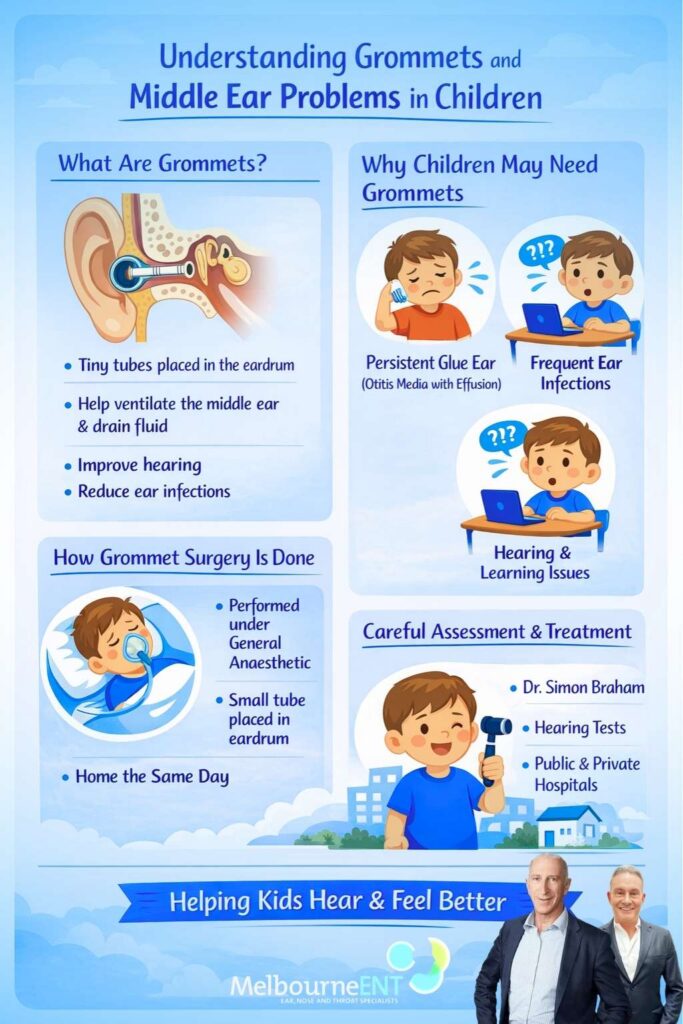
Grommets, also called ventilation tubes or tympanostomy tubes, are tiny hollow tubes placed through a small opening in the eardrum. Their purpose is to let air move into the middle ear and allow fluid to drain away. By improving ventilation and drainage, grommets can reduce the risk of persistent fluid and help improve hearing in many children who have had problems with glue ear or recurrent infections.
Once in place, a grommet stays in the eardrum for several months, sometimes longer, before gradually working its way out. The eardrum then usually heals behind it. While the grommet is present, there is a small passage between the ear canal and the middle ear, which is why questions about water safety often arise.
✓ Why Children in Melbourne Need Grommet Surgery
Children in Melbourne and across Australia may be offered grommet surgery when they have glue ear, also known as otitis media with effusion, that does not improve over time or when they have repeated middle ear infections that interfere with hearing, comfort or daily life. Glue ear can make speech and classroom listening more difficult, and parents may notice that their child turns up the television, asks for repetition or seems distracted in noisy environments.
At Melbourne ENT, Dr Simon Braham assesses each child carefully, often with hearing tests and examination under a microscope. Grommets are recommended when they are likely to provide a clear benefit and when non surgical options are no longer effective. The decision is always made in partnership with the family, with time allowed to discuss likely benefits and possible risks.
✓ How Grommet Surgery Is Performed
Grommet surgery is usually a short day procedure performed under a general anaesthetic. The child is asleep while the surgeon gently cleans the eardrum, makes a small opening and places the grommet into this opening so that it sits securely in the eardrum. No external stitches are required and there are no cuts on the outside of the ear. Most children are able to go home the same day once they are awake, comfortable and have had something to drink and eat.
In Melbourne, grommet surgery is performed in both public and private hospitals. Dr Simon Braham operates at private hospitals associated with Melbourne ENT, including Masada Private Hospital in St Kilda East, and also holds public appointments at the Royal Victorian Eye and Ear Hospital and other Victorian hospitals. This combination of public and private experience supports comprehensive care for children needing ear surgery and aftercare.
Why Water Exposure Matters After Grommets
✓ How Water Could Affect the Ears
Because a grommet creates a small pathway through the eardrum, there is a theoretical possibility that water entering the ear canal could pass through the tube and reach the middle ear. If that occurs, it may irritate the lining of the middle ear or introduce bacteria that could lead to ear discharge or infection. For many years this concern led to strict advice about keeping the ears absolutely dry.
More recent studies and clinical guidelines suggest that normal surface swimming in clean, treated pool water does not significantly increase the risk of ear discharge for most children with grommets. Water generally needs to be under higher pressure or contaminated to pass through the tube and cause problems. This has allowed recommendations to become more balanced and less restrictive for many families.
✓ Balancing Everyday Life and Ear Safety
For families in Melbourne, swimming and water play are part of everyday life. School programs, local swim schools, visits to Port Phillip Bay and holidays around Victoria often include water based activities. Understandably, parents do not want to stop these activities completely, but they also want to protect their child’s ears.
At Melbourne ENT, guidance about swimming and bathing is tailored to each child. The goal is to allow children to stay active where possible while reducing the risk of infections and complications. For some children, this may mean fairly relaxed rules about pool swimming. For others, particularly those who have had complex ear disease, stricter limits and more consistent ear protection may be advised.
When Can My Child Swim or Bathe After Grommet Surgery?
✓ The First One to Two Weeks After Surgery
In the first one to two weeks after grommet insertion, most ENT specialists recommend keeping water out of the ears as much as reasonably possible. This early healing period allows the ear canal and eardrum to settle and reduces the chance of irritation or early infection. Swimming is usually avoided during this time, and care is taken with showering and bathing so that water is not directed straight into the ear canal.
Families receive written post operative instructions from the hospital and from Melbourne ENT. These instructions may include suggestions such as using a gentle shower instead of deep baths, avoiding putting the head under water and supervising young children closely at bath time. The individual advice you receive should always take priority, as it is based on your child’s specific procedure and medical history.
✓ Returning to Normal Water Activities
Once the ears feel comfortable, there is no discharge and the early recovery period has passed, many children can gradually return to their usual water activities. For a large number of children this means going back to surface swimming in a clean, chlorinated pool. Some may be able to resume beach and bay swimming with sensible precautions, while others may be advised to be more cautious around untreated water.
During follow up visits at Melbourne ENT, parents are encouraged to raise questions about upcoming swimming lessons, school programs, camps and holidays. This allows Dr Simon Braham to give personalised advice on timing and specific activities, including whether ear plugs are recommended for that child and when they can safely return to their usual level of water exposure.
Swimming With Grommets – Practical Guidance for Families
✓ Swimming Pools in and Around Melbourne
For many children, surface swimming in a well maintained, chlorinated pool is considered low risk once grommets have settled. Treated pool water is filtered and disinfected to limit bacteria, and the pressure at the water surface is usually not high enough to force water through a ventilation tube. Studies comparing children who swim in pools with those who avoid swimming have not shown large differences in ear discharge rates for most children with grommets.
Some families prefer their child to wear soft ear plugs or a swimming cap, particularly in busy indoor pools or for children who swim frequently in squads or clubs. In some cases, Dr Simon Braham may suggest ear protection for regular swimmers or for children who have had previous episodes of discharge triggered by swimming. For many children who swim casually, however, routine ear plugs may not be strictly necessary, and this is discussed on an individual basis.
✓ Beaches, Bays, Lakes and Rivers
Natural water environments such as Port Phillip Bay, Western Port, local rivers and lakes can be more variable in cleanliness than treated pools. Heavy rain, run off and high usage can increase bacteria levels and may raise the risk of ear infections in children with grommets. Some research suggests that swimming in untreated or so called dirty water is associated with higher rates of ear discharge than swimming mainly in clean pool water.
Because of this, many ENT specialists recommend extra care with natural water. Families may choose to focus on pool swimming for regular exercise and be more selective about sea or river swimming, especially if the child has a history of ear problems. When natural water swimming is planned, ear plugs, shorter sessions and avoiding dunking or diving may be advised. These issues can be explored in detail with Melbourne ENT before holidays or summer activities.
✓ Diving, Underwater Swimming and Rough Play
Diving deeply, jumping into water from height and vigorous rough play all increase water pressure on the eardrum. Higher pressure is more likely to push water through the grommet into the middle ear. For this reason, children with grommets are usually advised to avoid deep dives, repetitive underwater swimming and games that involve being pushed under water while the tubes are in place.
Children who enjoy diving or who participate in water sports such as water polo or underwater hockey may need specific guidance. During consultations at Melbourne ENT, Dr Simon Braham discusses these higher pressure activities and may suggest limits or the use of custom ear plugs for certain sports. The aim is to protect the ears while keeping involvement in sport as safe and practical as possible.
Bathing and Showering With Grommets – Day to Day Care at Home
✓ Showers and Hair Washing
Everyday bathing is an important part of family routine, and most children with grommets can shower normally with a few simple adjustments. It is usually sensible to avoid directing a strong jet of water straight into the ear canal. Turning down the shower pressure, asking the child to face away from the spray while hair is rinsed and gently towel drying around the outer ear afterwards can all help reduce the chance of water entering the ear canal in large amounts.
In some cases, particularly in the early weeks after surgery, temporary protection may be suggested for hair washing. This could involve placing a small piece of cotton wool dipped in petroleum jelly in the outer part of the ear canal during the shower, then removing it immediately afterwards. If this is advised, the team at Melbourne ENT will explain exactly how to do it and for how long it should continue.
✓ Baths, Bath Toys and Siblings
Bath time can be messy and fun, especially when siblings are in the bath together. Children with grommets do not always need to avoid baths, but long periods where the ears are fully submerged in soapy water may be unhelpful. Soapy bath water, combined with repeated dunking, can irritate the skin of the ear canal and may increase the chance that water and product reach the middle ear.
Parents may find it easier to keep bath water a little shallower and encourage children to keep their head mostly above water, particularly in the first weeks after surgery. Some families choose to switch to showering most of the time, using baths for shorter, supervised play rather than long soaking. Young children who enjoy putting their head under water can be gently reminded to avoid this while grommets are present.
✓ Simple Protective Options
Many products are available to protect the ears in water, including soft silicone ear plugs, mouldable plugs and neoprene headbands. Some children like the sense of security they provide, while others find them uncomfortable. The current evidence suggests that routine use of ear plugs for all water exposure is not necessary for most children with grommets, particularly for gentle surface swimming in clean pools.
However, ear plugs may still be useful in selected situations, such as for frequent swimmers, for children who swim in natural water or for those who have had repeated episodes of ear discharge related to water exposure. If plugs are recommended, custom made plugs fitted by an audiologist can be more comfortable and less likely to fall out. Melbourne ENT can advise whether referral for custom plugs is appropriate for your child.
When Extra Caution Is Needed
✓ Children With a History of Ear Problems
Not all children with grommets have the same level of risk. Some have a long history of difficult ear infections, previous ear surgery or other medical conditions that affect ear health. In these situations, Dr Simon Braham may advise stricter water precautions, including more consistent use of ear protection or avoiding certain activities, at least for a period of time.
At Melbourne ENT, water safety advice is based on a full understanding of the child’s ear history, hearing test results and overall health. This individualised approach helps to provide a level of protection that is appropriate for each child rather than applying the same rules to everyone.
✓ Recent or Ongoing Ear Discharge
If a child with grommets develops ear discharge, it usually means that the middle ear is inflamed or infected. While the grommet often allows the infection to drain more easily, swimming or getting large amounts of water into the ear is generally avoided until the discharge has settled and the ear has been reviewed. Treatment often involves prescribed ear drops and sometimes cleaning of the ear canal by a doctor.
Parents should seek medical advice if they notice fluid leaking from the ear, particularly if there is an odour, blood in the discharge, ongoing pain or fever. The team at Melbourne ENT can advise whether an urgent review is required or whether initial assessment by a GP is appropriate.
✓ School Camps, Swimming Carnivals and Holidays
School camps, swimming carnivals and family holidays often involve more intense water exposure than a normal week at home. Planning ahead can make these events safer and less stressful. Parents may wish to ask the school or camp what water activities are planned, then discuss these with Melbourne ENT or their GP.
Sometimes a brief written plan is helpful, outlining that the child can participate in surface swimming in a pool but should avoid deep diving or lake swimming. Families planning holidays that revolve around water sports may also consider the timing of grommet surgery and discuss with Dr Simon Braham how to balance medical needs with travel plans.
Warning Signs After Swimming or Bathing
✓ Symptoms to Watch For
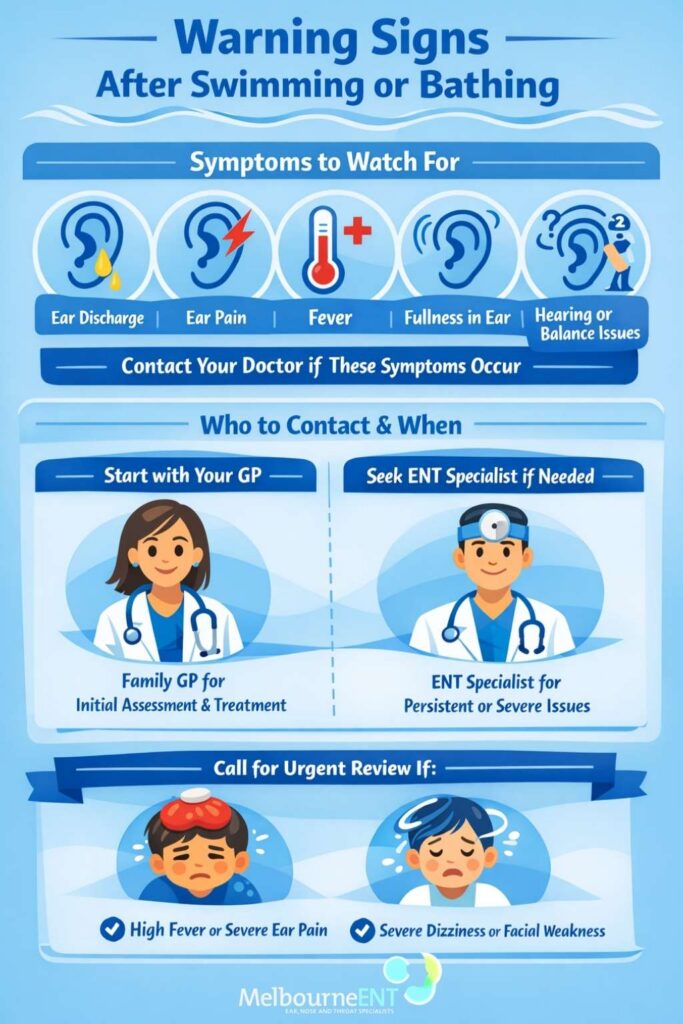
After swimming or bathing, parents should keep an eye out for certain symptoms. New ear discharge, persistent ear pain, fever, a sense of fullness in the ear that does not settle, or sudden changes in hearing or balance should all prompt medical review. These symptoms do not always indicate a serious problem, but they should be checked, particularly when grommets are in place.
Because grommets allow fluid to drain, discharge can be a sign that the tube is doing its job by allowing infection to come out of the middle ear rather than stay trapped behind the eardrum. With timely assessment and appropriate treatment, most episodes of discharge can be managed effectively.
✓ Who to Contact and When
In most situations, the first point of contact for new symptoms is the family GP. The GP can examine the ears, decide whether the problem is in the outer ear or middle ear and start treatment where appropriate. If infections keep recurring, do not settle or raise additional concerns, referral or return to an ENT specialist is often recommended.
Families who are already seeing Melbourne ENT can contact the clinic for guidance about whether an earlier review is needed. Urgent assessment may be necessary if a child is very unwell, has severe pain or has concerning symptoms such as severe dizziness or weakness of the facial muscles, although these situations are uncommon.
How Melbourne ENT and Dr Simon Braham Support Families
Expertise in Paediatric Ear and Grommet Surgery
Dr Simon Braham is an experienced ENT surgeon in Melbourne who regularly performs grommet surgery, as well as tonsil and sinus procedures for both children and adults. He holds FRACS qualification and practises through Melbourne ENT at Masada Medical Centre in St Kilda East, with additional consulting in Sunbury and public appointments at the Royal Victorian Eye and Ear Hospital and regional hospitals.
This mix of public and private work supports a broad understanding of common and complex ear, nose and throat conditions and allows coordinated care for families across different settings.
Individualised Advice About Water and Everyday Activities
Appointments at Melbourne ENT include time to discuss practical issues such as swimming, bathing, school activities and travel. Rather than applying overly strict or outdated rules, Dr Simon Braham uses current evidence and his clinical experience to provide advice that fits the individual child.
For one child this might mean a fairly relaxed approach to pool swimming, while another might need more structured precautions around ocean swimming and diving. By talking through the details of your child’s routine and upcoming plans, you can work with Melbourne ENT to develop a realistic approach that feels safe and achievable.
Ongoing Follow Up and Shared Care
Grommets are a temporary measure rather than a permanent implant. Regular follow up appointments help ensure that the tubes remain in the correct position, that hearing is improving as expected and that there are no ongoing issues such as repeated discharge or persistent fluid.
Melbourne ENT works closely with GPs, audiologists and, when needed, speech pathologists and other professionals. This shared care model helps to pick up any additional concerns around hearing, speech or learning and ensures that children receive coordinated support across their healthcare and school environments.
Medicare Coverage and Grommet Surgery Costs
In Australia, medically necessary grommet surgery is generally eligible for support from Medicare when it is performed by a specialist and billed under the appropriate Medicare Benefits Schedule item number, such as item 41632 for insertion of ventilation tubes in the ear. Medicare usually pays a rebate based on the schedule fee for the surgeon’s service.
There may still be out of pocket costs, particularly in private hospitals, because surgeon, anaesthetist and hospital fees can be higher than the Medicare schedule fee. Private health insurance with hospital cover can reduce some of these costs for eligible patients, although excesses and gaps may still apply.
Melbourne ENT provides information about common ENT Medicare item numbers and general guidance around Medicare rebates on its pricing pages, and the reception team can help families understand which item numbers may apply to a planned procedure. Before surgery, patients receive informed financial consent that outlines estimated fees and likely rebates so they can plan ahead. For the most accurate information, it is always best to confirm details with Medicare, your private health insurer and the clinic directly.
Preparing for an Appointment About Grommets and Water Safety
✓ Questions Parents May Wish to Ask
Before attending an appointment at Melbourne ENT, parents may find it helpful to think about the questions that matter most to their family. Many parents want to know when their child can safely return to swimming lessons, whether ear plugs are needed all the time or just in certain settings, how to manage bath time and hair washing at home and what to do if symptoms appear after water exposure.
Raising these questions during the consultation gives Dr Simon Braham the chance to address specific concerns, correct any misunderstandings and give practical, tailored advice. Talking about upcoming school programs, camps and holidays also allows forward planning so that water activities can be managed calmly and safely.
✓ Information to Bring to Your Consultation
Bringing key information to your appointment can make it easier to give precise advice. Helpful details include the child’s past ear infection history, results of hearing tests or audiology reports, previous ear operations and any other significant medical conditions. Reports from teachers or speech pathologists can also highlight how ear problems may be affecting learning or communication.
Information about your child’s usual swimming habits is also valuable. Letting Melbourne ENT know whether your child swims casually, trains with a squad, loves diving to the bottom of the pool or spends long periods at the beach can all influence the recommendations about water exposure after grommets.

FAQs About Swimming and Bathing With Grommets
Can my child wear ear plugs every time they swim, or can that cause other problems?
Some children are very happy wearing ear plugs, while others find them uncomfortable or difficult to keep in place. Wearing suitable ear plugs in the pool is generally safe, but if they do not seal properly they can fall out or trap water in the outer ear. Certain materials may also irritate the skin when used for long periods. If you are considering regular or daily use, it is best to discuss this with your ENT specialist at Melbourne ENT so they can advise on whether plugs are needed and which type may suit your child.
Is it safe to use over the counter ear drying drops after swimming if my child has grommets?
Many over the counter drying or alcohol based ear drops are designed for people with an intact eardrum. When grommets are present, these products can reach the middle ear and may cause pain or irritation. For that reason they are usually not recommended for children with grommets unless an ENT specialist has specifically said they are safe. If your child often has water sitting in the outer ear after swimming, it is better to ask your doctor or Melbourne ENT for advice rather than using drying drops on your own.
Could swimming with grommets affect how long the tubes stay in the eardrum?
The length of time a grommet stays in place is mainly influenced by the type of tube, the child’s age and how quickly their eardrum heals. Normal surface swimming in clean water is not known to make grommets fall out faster. Repeated infections and discharge can sometimes influence how the eardrum heals, which is one reason why sensible water precautions and timely treatment of any problems are important. Your ENT specialist will monitor tube position during follow up visits and advise when the grommets have come out.
Can hair products like shampoo or conditioner irritate my child’s ears when they have grommets?
Shampoo, conditioner and soapy bath water can sometimes irritate the delicate skin of the ear canal, particularly if they sit in the ear for a long time. If water and product pass through the grommet they may also irritate the middle ear. This is why simple steps such as turning the shower away from the ears, rinsing gently and avoiding prolonged submersion in soapy bath water are often suggested. If your child complains of stinging, itching or discomfort during hair washing, mention this at your next appointment so the routine can be adjusted if needed.
What should I tell my child’s swimming teacher or coach about their grommets?
It can be helpful to let swimming teachers know that your child has grommets and to share any advice from Melbourne ENT. You might explain that they should stay in the shallow end, avoid deep diving or rough games that involve being pushed under water, or that they use ear plugs in certain sessions. Clear, simple instructions allow instructors to support your child’s confidence in the water while respecting medical guidance. Many Melbourne swim schools are familiar with grommets and are happy to adapt activities when needed.
How can I help my child feel confident in the water again after ear problems and surgery?
Some children become anxious about water after painful ear infections or after being told to keep their ears dry for a period of time. Once your ENT specialist is comfortable for your child to return to water activities, it often helps to restart gradually. Short, positive experiences in shallow water, plenty of reassurance and allowing your child to progress at their own pace can support confidence. Explaining, in age appropriate language, what Dr Simon Braham has said about what is now safe can also reduce fear.
Is it safe to fly on holiday and then let my child swim soon after a flight if they have grommets?
For many children, flying with grommets is actually more comfortable than flying without them because the tubes help equalise pressure. In most cases there is no strict rule that prevents swimming after a flight, provided the ears feel comfortable and there is no discharge or pain. However, holidays often involve new environments such as resort pools, water parks and beaches that differ from usual swimming conditions. Before travelling, it is sensible to ask your GP or Melbourne ENT for trip specific advice so you know what is appropriate where you are going.
Medical References
- Ventilation tubes (grommets) for otitis media with effusion (OME) in children – Cochrane Database of Systematic Reviews – https://pmc.ncbi.nlm.nih.gov/articles/PMC10646987/
- Tympanostomy Tube Insertion – StatPearls – NCBI Bookshelf – https://www.ncbi.nlm.nih.gov/books/NBK565858/
- Paediatric post-grommets surgery review: Audiology-led clinic – International Journal of Pediatric Otorhinolaryngology – https://pubmed.ncbi.nlm.nih.gov/38996474/
- Reimagining grommet follow-up care: audiology-led outcomes and healthcare cost savings – BMJ Innovations – https://pmc.ncbi.nlm.nih.gov/articles/PMC12584533/
- Otitis Media With Effusion – StatPearls – NCBI Bookshelf – https://www.ncbi.nlm.nih.gov/books/NBK538293/
- A Novel Long-Term Tympanostomy Tube: The U-Tube – PMC – https://pmc.ncbi.nlm.nih.gov/articles/PMC12838219/
- Clinical Practice Guideline: Tympanostomy Tubes in Children (Update) – Otolaryngology–Head and Neck Surgery – https://pure.johnshopkins.edu/en/publications/clinical-practice-guideline-tympanostomy-tubes-in-children-update
Next Steps – Getting Personalised Advice
Every child and every set of ears is different, so decisions about swimming, bathing and other water activities after grommet surgery should always be personalised. If you are unsure what is appropriate for your child, the best step is to talk with your GP and, if needed, seek a referral to an ENT specialist.
At Melbourne ENT in St Kilda East, Victoria, Dr Simon Braham offers detailed assessment and discussion for children who may need grommets or already have them in place. Consultations cover not only the procedure itself but also practical guidance on water safety, school activities, travel and long term ear care.
To learn more about grommet surgery, Medicare rebates and the services offered at Melbourne ENT, or to arrange an appointment for your child, you can contact the practice directly or visit related pages on the website.
Further Reading
- Read more about Middle Ear Infection (AOM)
- Read more about Ear Ache
- Read more about Tinnitus Melbourne
- Read Melbourne ENT’s Blog on Do you have Ear Pain when Flying? – Effects of Barotrauma
- Read Melbourne ENT’s Blog on Middle Ear Aeration Methods: How Can They Help?
- Read Melbourne ENT’s Blog on How to Use Hydrogen Peroxide Ear Drops
Can My Child Swim or Bathe With Grommets?
When a child needs grommets Melbourne, many parents feel relieved that something is being done…
Why Ear Infections Spike In Summer And How To Prevent Swimmer’s Ear
Summer in Melbourne usually means warm evenings at St Kilda Beach, endless laps at local…
Summer Ear Health Tips for Children Who Swim
Summer in Melbourne often means long days by the pool, swimming lessons, and family trips…