

At Melbourne ENT, located in St Kilda East, Victoria, we specialise in comprehensive ENT care including the highly effective adenotonsillectomy procedure. Our team is led by Dr Stephen Kleid and Dr Simon Braham, both FRACS-qualified ENT and Head & Neck Surgeons. This surgery primarily addresses functional issues such as chronic infections, bad breath and airway obstruction. Whether treating a child with sleep-disordered breathing or an adult suffering from recurrent tonsillitis, our specialists deliver safe and evidence-based care tailored to each patient. With decades of collective experience, we are proud to offer a high standard of care in a supportive and compassionate environment, ensuring every patient feels heard, understood, and fully informed. We have a team that will fully support you from the initial consultation through the operation and the recovery and make the process as pleasant as possible. We understand your fears for the safety of your child in the operation and managing the recovery process.
What Is Adenotonsillectomy?
An adenotonsillectomy is the surgical removal of the adenoids and tonsils, lymphoid tissues located at the back of the nasal cavity and throat, respectively. This procedure is most often performed in children but is often necessary in adults too. It is primarily recommended for those who experience chronic or recurrent infections, obstructed breathing, or other upper airway complications. In addition to resolving physical symptoms, adenotonsillectomy can also contribute to improved sleep patterns, better energy levels, and reduced frequency of doctor visits. It is a functional procedure with significant health benefits, aimed at improving breathing, reducing infections, and addressing quality of life. In some cases, the removal of adenoids and tonsils can also aid in resolving chronic middle ear fluid, reduce nasal speech, and improve facial growth patterns or teeth grinding in children with long-term nasal obstruction and reduce the need for braces later.
Who Needs It (Candidates For Adenotonsillectomy)
Adenotonsillectomy is considered for individuals experiencing persistent health issues related to the tonsils and adenoids. This includes repeated episodes of tonsillitis, often more than five times a year, which can lead to missed school or work and ongoing discomfort. It is also indicated for individuals who suffer from sleep apnoea or habitual snoring, especially when these issues impact quality of sleep or overall health. Children who consistently breathe through their mouths, have difficulty swallowing, dental problems, teeth grinding or exhibit behavioural issues potentially linked to poor sleep may also benefit. Adults, may require surgery if they experience chronic throat infections, tonsil stones, bad breath or airway obstruction. The decision for surgery is based on a comprehensive evaluation, balancing symptom severity with potential benefits and risks.
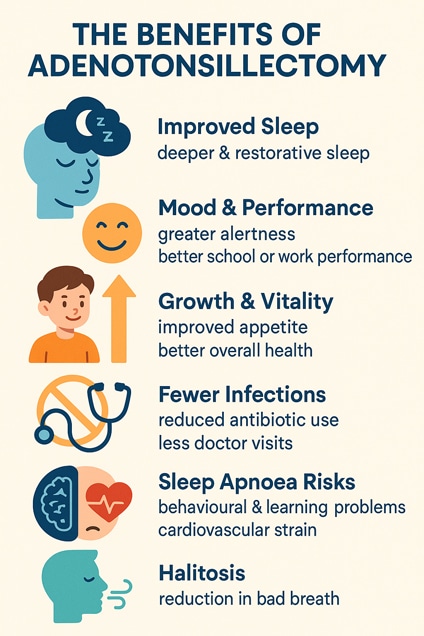
Benefits Of Adenotonsillectomy
The benefits of adenotonsillectomy extend beyond the immediate relief of symptoms. Patients often experience dramatic improvements in breathing, especially at night, leading to deeper and more restorative sleep. This can translate to better mood, greater alertness, and better performance at school or work. Children may see gains in appetite, growth, and overall vitality following the procedure. The reduction in throat and ear infections significantly decreases reliance on antibiotics and frequent medical visits, which contributes to long-term health and cost savings. Additionally, resolving sleep apnoea can reduce associated risks such as behavioural challenges, learning difficulties, facial growth abnormalities and cardiovascular strain. For many families, the improvement in a child’s wellbeing also alleviates parental stress and restores household routines disrupted by ongoing illness. Adults with tonsil stones or bad breath or sleep-disordered breathing from having their tonsils removed notice significant improvements.
Consultation For Adenotonsillectomy
Every successful surgical outcome begins with a thorough and empathetic consultation. At Melbourne ENT, we prioritise personalised evaluations tailored to each patient’s symptoms, health history, and treatment goals. During this initial visit, your surgeon will discuss all aspects of the condition, from how often infections occur to how sleep and breathing may be affected. A gentle but detailed examination of the throat, nasal passages, and ears will help assess the size and health of the tonsils and adenoids. Where required, we may utilize nasendoscopy or refer for imaging studies to gather additional diagnostic information. For children, we maintain a calm, reassuring environment and encourage family involvement to ensure everyone feels comfortable and informed. The consultation concludes with a clear discussion of treatment options, expected outcomes, and answers to any questions or concerns.
How Is It Performed (Surgery For Adenotonsillectomy)
Adenotonsillectomy is performed under general anaesthesia, ensuring the patient is completely asleep and pain-free during the operation. The surgery typically takes between 30 to 60 minutes, depending on individual anatomy and whether additional procedures, such as ear tube placement, are required. The surgeon accesses the tonsils and adenoids through the mouth, meaning there are no external incisions or visible scars. Advanced techniques such as electrocautery or coblation are used to carefully remove the tissues while minimising blood loss and trauma to surrounding areas. Once the tissues are removed, the surgical site is monitored and any residual bleeding is controlled. Patients are usually observed in recovery before being discharged the same day, although some children or higher-risk individuals may benefit from an overnight hospital stay. Our surgeons use techniques specifically chosen to reduce postoperative discomfort and promote a faster return to normal activities.
Recovery After Adenotonsillectomy
At Melbourne ENT we endeavor to make the recovery from adenotonsillectomy as straightforward as possible. We understand that the recovery and the expected pain is our patients biggest fear. To minimise pain and swelling we use advanced surgical techniques such as coablation (see section on coablation). Our anesthetists are experts in pain management and will prescribe medication to reduce pain, swelling and bleeding. They will be available to help you through the recovery if you need any advice with the medication. Our nursing staff at Masada are very experienced in looking after tonsillectomy patients and will hold your hand through the recovery if needed. You will be given a phone number to call 24 hours a day if any help is needed. In the initial days, most patients experience a sore throat, which may be accompanied by ear pain due to referred sensation. Mild fever and reduced appetite are also common. The discomfort generally peaks around the third to fifth day, after which symptoms steadily improve. It is essential to maintain hydration and provide soft, soothing foods to aid in recovery and comfort. By the end of the first week, most children begin to resume their regular diet and activities, although full healing continues over 10 to 14 days. During this time, strenuous physical activity should be avoided to minimise the risk of postoperative bleeding. Voice changes, nasal tone alterations, and temporary bad breath may occur but usually resolve without intervention. Follow-up care includes monitoring healing progress and addressing any questions or concerns that arise during recovery.
Risks And Complications Of Adenotonsillectomy
While adenotonsillectomy is considered a safe and routine procedure, it is important to be aware of potential risks. The most common concern is postoperative bleeding, which may occur within the first 10 days after surgery. Infection, although rare, can develop and may require medical treatment. Temporary changes in voice, taste, or swallowing are possible but usually improve over time. Anaesthetic risks are minimal but present, as with any surgery involving general anaesthesia. In some cases, particularly in very young children, dehydration may become an issue if fluid intake is insufficient due to throat pain. Very rarely, some patients may experience regrowth of adenoidal or tonsillar tissue or incomplete resolution of symptoms. Our team ensures that every patient is well-informed about these risks and receives clear instructions on recognising warning signs and knowing when to seek prompt medical care.
Cost Of Adenotonsillectomy
The cost of adenotonsillectomy depends on several variables, including the surgeon’s fees, hospital admission type, anaesthesia, and whether other procedures like grommets are needed at the same time. Patients with private health insurance may find that a significant portion of these expenses is covered, though some out-of-pocket fees will still apply. We provide each patient with a personalized cost estimate during the consultation, tailored to their specific clinical needs and health cover details. Transparency is a core value at Melbourne ENT, and we are committed to ensuring patients understand their financial obligations prior to proceeding. We encourage all patients to contact their insurance provider ahead of time to clarify coverage and identify any gaps in reimbursement.
Medicare Coverage And Insurance
Adenotonsillectomy typically qualifies for Medicare rebates either 41789 or 41793 depending on your child age. In many cases, this procedure is also included in the hospital cover of private health insurance policies. Our administrative team is well-versed in navigating insurance paperwork and can assist with confirming eligibility, and estimating out-of-pocket costs. For uninsured patients or those with limited cover, we offer guidance on public hospital referrals or quotes for self paying patients. We recommend reviewing your policy details and checking for applicable waiting periods or exclusions related to surgical treatment, especially if recent changes to your health cover have been made.
Why Choose Your Surgeon
At Melbourne ENT, we believe that choosing the right surgeon is the cornerstone of a successful treatment experience. Dr Stephen Kleid brings more than four decades of ENT surgical expertise and has held prominent roles in both public and private healthcare. His extensive background in managing complex cases of airway obstruction and head and neck surgery supports a steady, capable approach to adenotonsillectomy. Dr Simon Braham has 3 decades of experience with adenotonsillectomy and combines surgical precision with a calm, compassionate manner, particularly valued by paediatric patients and their families. His dual fellowship training, including time spent in New York and Boston, equips him with a global perspective and up-to-date ENT surgical techniques. Together, they represent a blend of deep experience and innovative practice. Patients at Melbourne ENT can expect continuity of care, clear communication, and a commitment to excellence at every stage of their journey.
FAQs About Adenotonsillectomy
Can removing tonsils and adenoids affect a child’s voice or speech development?
In some cases, children may experience temporary changes in voice tone or resonance after surgery. These usually resolve as swelling decreases and the throat heals. Long-term effects on speech are uncommon, and many children experience improved speech clarity if nasal obstruction was previously impacting their articulation.
What are some signs that adenoids are contributing to sleep or behavioural issues in children?
Common signs include loud snoring, restless sleep, mouth breathing, and frequent waking at night. Children may also display daytime fatigue, irritability, or difficulties with attention and learning. If these behaviours improve when the child is unwell or using nasal sprays, enlarged adenoids may be a contributing factor.
How do I know if my child’s snoring is something that needs surgical treatment?
Occasional snoring is common and not always a concern. However, if your child snores regularly, pauses breathing during sleep, appears very tired during the day, or has been diagnosed with obstructive sleep apnoea through a sleep study, surgical treatment such as adenotonsillectomy may be recommended.
Are there any long-term effects on immunity after tonsils and adenoids are removed?
The tonsils and adenoids are part of the immune system, but their removal does not significantly impair immune function. Other lymphatic tissues continue to provide immune protection. Most patients experience fewer infections after surgery, and their general health and resistance to illness often improve.
Can adults benefit from adenotonsillectomy even if they didn’t have frequent infections as children?
Yes, adults who develop chronic tonsillitis, tonsil stones, halitosis (bad breath) , obstructive sleep apnoea, or airway obstruction can benefit from this procedure. The recovery may be slightly more prolonged in adults, but the improvement in symptoms such as sleep quality and throat discomfort can be substantial.
What happens if only the adenoids or only the tonsils are problematic?
If examination or imaging reveals that only one structure is enlarged or causing symptoms, the surgeon may recommend removing just the tonsils or just the adenoids. Each case is assessed individually, and a conservative approach is taken when appropriate.
How do surgeons decide whether adenotonsillectomy is the best course of action over medication or observation?
The decision is based on a combination of symptom frequency, impact on daily life, response to previous treatments, and physical examination findings. If infections are persistent despite medical therapy or if airway obstruction or tonsil stones are significantly affecting quality of life, surgery becomes the preferred option.
Sources:
- Impact of Adenotonsillectomy on Quality of Life in Pediatric Obstructive Sleep Apnea
https://pmc.ncbi.nlm.nih.gov/articles/PMC12170811/ - Adenotonsillectomy and Health Care Utilization in Children With Snoring and Mild Sleep Apnea: A Randomized Clinical Trial
https://jamanetwork.com/journals/jamapediatrics/fullarticle/2831334 - Long-term effects of adenoidectomy and tonsillectomy on frequency and severity of acute respiratory infections in children: a systematic review
https://www.msjonline.org/index.php/ijrms/article/view/14201 - Tonsillectomy and Adenoidectomy – StatPearls – NCBI Bookshelf
https://www.ncbi.nlm.nih.gov/books/NBK536942/ - Impact of Adenotonsillectomy on Weight Gain in Children – MDPI
https://www.mdpi.com/2227-9067/12/3/270 - Effects of tonsillectomy and adenoidectomy on the immune system – ScienceDirect
https://www.sciencedirect.com/science/article/pii/S2405844024081477 - Efficacy and Safety of Adenotonsillectomy for Pediatric Obstructive Sleep Apnea – MDPI
https://www.mdpi.com/2036-7503/17/4/71
Book Your Consultation Today
To arrange an adenotonsillectomy consultation for yourself or your child, please contact our practice. Dr Stephen Kleid can be reached on (03) 9038 1630 and Dr Simon Braham on (03) 9038 1311. For more information about their services and professional backgrounds, visit the website. We welcome your enquiry and look forward to assisting you with expert ENT care. Our team is here to help you breathe easier, sleep better, and enjoy the long-term health benefits of personalised surgical treatment. Whether your concerns have developed recently or have been ongoing for some time, our experienced surgeons are committed to delivering care that is compassionate, skilled, and tailored to your needs.
Further Reading
- Read about Melbourne ENT’s Adenoidectomy Melbourne
- Read about Melbourne ENT’s Microlaryngoscopy Melbourne
- Read about Melbourne ENT’s Palatoplasty Melbourne
- Read about Melbourne ENT’s Adult Tonsil Surgery Melbourne
- Read about Melbourne ENT’s Tonsil Surgery for Kids in Melbourne
Why Choose Dr Kleid ?

Dr Stephen Kleid,
Melbourne ENT Surgeon
MED0001052799
Dr Stephen Kleid is an experienced ENT Surgeon (Otolaryngologist) based in Melbourne with a passion for Septo-rhinoplasty, Septoplasty and a strong interest in Rhinoplasty Revision.
Qualifications
- AHPRA (Medical Board)
- MB, BS; FRACS (Fellow of the Royal Australasian College of Surgeons)
- AAFPS – Member of the Australasian Academy of Facial Plastic Surgery
- AAFPRS – (International Member of the American Academy of Facial Plastic and Reconstructive Surgeons)
Dr Kleid’s Procedures
Why Choose Dr Braham ?

Dr Simon Braham,
Melbourne ENT Surgeon
MED0001144757
Dr Simon Braham MBBS (Hons) FRACS is an experienced Ear, Nose and Throat ENT Surgeon (Otolaryngologist) based in Melbourne, performing tonsil, grommet and sinus surgery for children & adults. He helps patients with breathing issues, snoring concerns and sleep disturbances.
Dr Braham’s Procedures
How can we help?
The Melbourne ENT Team takes pleasure in assisting you with any questions when considering a plastic surgery procedure. Please call the St Kilda East clinic in Melbourne between 9am – 5 pm on Weekdays.
What Next?

Want more information about your Procedure?
- Please read our website and blogs to find out more about your procedure and concerns
- For more information about pricing and payment methods, please visit our page on Surgery Payment Options.
- Talk to our Patient Care Team from 9 am to 5 pm Monday to Friday

What to Bring to Your Consultation
- We encourage you to bring a friend or family member to accompany you, as they can provide an extra perspective and support throughout the process.
- It is important to take thorough notes and carefully review all the documents provided to you.

How to Book a Consultation
- A valid medical referral from your GP or Specialist is necessary to see a surgeon for a consultation.
- Check our pricing page
- Please contact us to book your consultation.