


For many people in Melbourne and across Victoria, flying is a regular part of life. Work trips to Sydney, family holidays to Queensland, and long haul flights overseas are part of everyday routines. For some adults and children, though, flying is overshadowed by something much less enjoyable than travel itself: sharp ear pain during take off and landing, blocked ears that do not clear for hours, and temporary hearing changes that can feel worrying or even frightening.
This type of ear pain is most often linked to a pressure problem in the middle ear called barotrauma. People sometimes refer to it as “airplane ear”. Mild barotrauma is very common and usually settles by itself, but more severe or repeated episodes can affect comfort, sleep, and the willingness to fly at all, especially for those who travel frequently for work or family reasons.
At Melbourne ENT in St Kilda East, ENT surgeon Dr Simon Braham regularly assesses and manages pressure related ear problems in adults and children from across Melbourne and regional Victoria. This article explains in clear language why ear pain happens when flying, what the effects of barotrauma can be, how it can be prevented or treated, and when it is worth seeing a specialist. It is general information only and does not replace advice from your own doctor.
How the Ear Works and Why Pressure Matters
✓ Basic ear anatomy explained simply
The ear can be thought of in three main sections. The outer ear is the visible part on the side of the head and the ear canal that leads inwards. At the end of the canal sits the eardrum, a thin flexible membrane that vibrates when sound waves reach it.
Behind the eardrum is the middle ear, a small air filled space that contains three tiny bones. These bones transmit sound vibrations from the eardrum towards the inner ear. The middle ear is connected to the back of the nose and upper throat by a narrow passage called the Eustachian tube. This tube is the key structure when we talk about pressure and flying.
The Eustachian tube normally stays closed and opens briefly when we swallow, yawn, chew, or move our jaw. Each time it opens, a small amount of air moves between the nose and the middle ear. This process equalises pressure on both sides of the eardrum so that it can move freely and sound can travel clearly.
Deeper in, the inner ear contains the cochlea for hearing and the balance organs. Airplane related ear pain is usually a problem of the middle ear and Eustachian tube, rather than the inner ear.
✓ What is ear barotrauma
Barotrauma is discomfort or injury caused by a difference in pressure. In the ear, barotrauma occurs when the pressure in the middle ear does not match the pressure outside the eardrum. When there is a difference between these two, the eardrum is pushed inward or outward and becomes stretched. This can be painful and can temporarily reduce hearing.
When the Eustachian tube is working well, it opens often enough to equalise pressure and prevent problems. If it is blocked, slow to open, or not functioning properly, pressure builds behind the eardrum. That pressure difference is the main cause of ear barotrauma on flights. People often describe it as ears that will not pop, a blocked or underwater feeling, or a heavy fullness on one side.
Most barotrauma is mild and short lived. In more severe cases, the pressure difference can cause fluid to collect in the middle ear, blood to appear behind the eardrum, or even a small tear in the eardrum.
Why Flying Causes Ear Pain

✓ What happens during take off and landing
Passenger aircraft cabins are pressurised, but not to sea level pressure. As a plane climbs after take off, cabin pressure gradually falls. As it descends before landing, cabin pressure increases again. These changes are most noticeable for the ears during the last part of the flight.
During ascent, air trapped in the middle ear expands as outside pressure decreases. Normally this extra air escapes through the Eustachian tube into the back of the nose when the tube opens. Many people notice this as a gentle pop in the ears. If the tube fails to open, pressure in the middle ear can stay higher than the cabin pressure and the eardrum may bulge outward.
During descent, the opposite happens. Cabin pressure rises as the aircraft approaches the ground. The pressure in the middle ear needs to rise too. To do that, air must move from the back of the nose through the Eustachian tube into the middle ear. This is often harder than letting air out. If the tube does not open often or widely enough, the middle ear remains at a lower pressure than the cabin, so the eardrum gets pulled inward. This is usually when pain and blockage are at their worst.
Because of this, ear pain and blocked sensations are more common and more intense during descent rather than take off. People who are asleep and not swallowing much are often more prone to symptoms at this time if their Eustachian tubes do not open easily.
✓ When the Eustachian tube cannot keep up
Many everyday conditions affect the Eustachian tube. A cold or flu, sinus infection, or upper respiratory virus causes the lining of the nose and throat to swell and produce more mucus. The narrow opening of the tube can then become partly blocked. Allergic conditions such as hayfever and chronic sinusitis can have a similar effect.
Some people have structural problems, such as a deviated nasal septum, nasal polyps, or chronic enlargement of the turbinates, that disrupt airflow and drainage. In children, enlarged adenoids can sit close to or over the tube openings and interfere with their function. Previous ear infections or surgery may also change how the tube and middle ear behave.
If the Eustachian tube cannot open easily, it will struggle to keep up with rapid pressure changes during flights. The pressure difference that builds up is experienced as pain, fullness, popping, or muffled hearing. When this happens on many flights, it suggests an underlying issue that is worth assessment.
✓ Ear barotrauma outside airplanes
Ear barotrauma is most commonly linked with flying, but it is not limited to aircraft. Divers can experience barotrauma when descending and ascending because water pressure changes more quickly than air pressure. Drivers passing through mountains or over high passes may notice their ears changing with altitude. People who work in pressurised environments or receive hyperbaric oxygen therapy can also encounter rapid pressure changes.
In all of these situations, if the Eustachian tube does not equalise pressure effectively, the middle ear pressure becomes mismatched with the surrounding environment, and barotrauma can result.
The Effects of Barotrauma: Symptoms and Possible Complications
✓ Mild effects that are common and usually short lived
Mild ear barotrauma is extremely common. People may feel a short lived sharp or dull ache in one or both ears during descent. Their ears can feel heavy, blocked, or stuffed with cotton. Sounds may be muffled or distant and there may be crackling or popping noises when swallowing or yawning.
In most mild cases, these symptoms improve shortly after landing. Active swallowing, yawning, chewing, or gentle pressure equalising techniques often help. Although the discomfort is usually brief, repeated mild episodes on every flight can still be distressing and may point to an underlying Eustachian tube problem.
✓ Moderate barotrauma when symptoms persist
Moderate barotrauma brings stronger or longer lasting symptoms. Pain can persist for a day or more after flying. The blocked sensation may not clear even with vigorous attempts to pop the ears. There may be a clear difference in hearing between one ear and the other. Some people feel slightly unsteady or lightheaded, although intense spinning dizziness is less typical at this stage.
In the middle ear, the eardrum may be clearly pulled inward. The pressure difference can cause fluid or a small amount of blood to leak into the middle ear space. This fluid further dampens the vibration of the eardrum and bones, prolonging that underwater feeling. Moderate barotrauma often improves without surgery, but it can take several days and may interfere with work, social activities, or enjoyment of a holiday.
✓ Severe barotrauma that needs urgent review
Severe barotrauma is less common but clinically important. A person may feel a sudden intense pain in the ear during descent, often followed by a distinct pop. Soon after, there may be discharge from the ear that is clear, blood stained, or mixed with mucus. Hearing on that side may fall sharply. Some people experience significant spinning dizziness, nausea, or vomiting.
These features suggest that the eardrum has torn or that there is extensive bleeding into the middle ear. In rare cases, inner ear structures can be affected, risking long term hearing loss or balance problems. Any sudden marked change in hearing, any ear discharge after severe pain, or any strong vertigo after a flight requires urgent medical attention and, in many cases, prompt ENT review.
Why Children Often Have More Ear Pain Than Adults
✓ Anatomy and development of the child’s ear
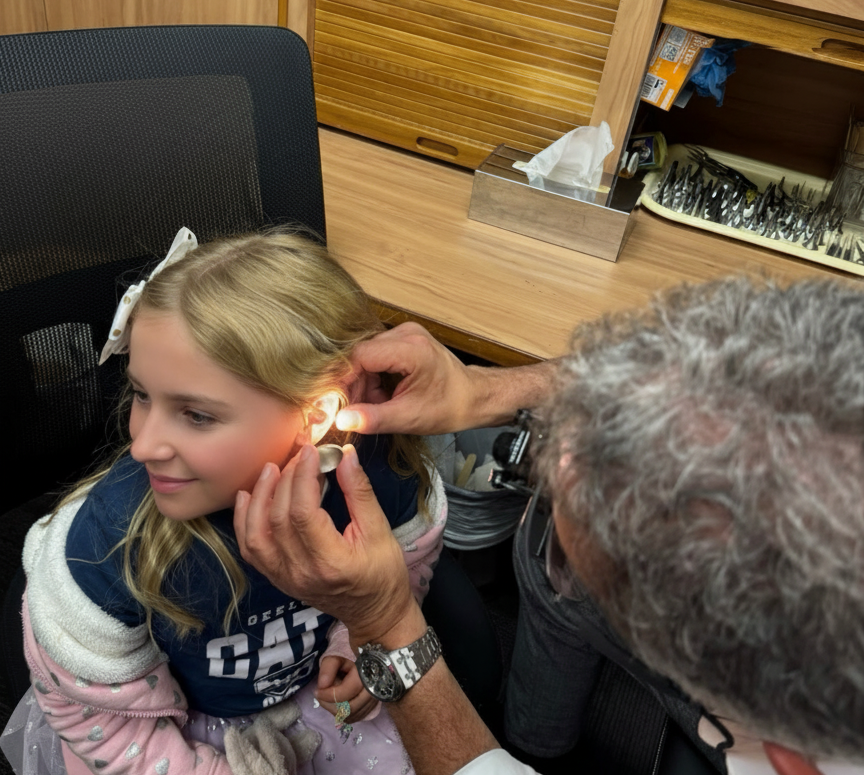
Children are more prone to barotrauma because of their anatomy and development. Young children have Eustachian tubes that are shorter, narrower, and more horizontal than those of adults. This shape makes it easier for mucus to block the tubes and harder for air to travel freely between the middle ear and the back of the nose.
As children grow, their skull and face change shape, the tubes lengthen and become more vertical, and their function usually improves. Until that happens, though, it is common for children to struggle with pressure equalisation on flights, especially when they have colds or nasal congestion.
✓ Frequent infections and enlarged adenoids
Children tend to catch viral infections more often than adults, especially in childcare and school settings. Each cold or flu can inflame the nose, throat, and Eustachian tube lining. Many children also experience repeated middle ear infections or glue ear, where fluid remains behind the eardrum for months. These conditions affect how well pressure can be balanced.
Enlarged adenoids at the back of the nose are another key factor. In some children, the adenoids partially block the Eustachian tube openings or interfere with drainage. This can increase the risk of both everyday ear problems and barotrauma during flights.
✓ How ear pain appears in infants and young children
Babies and toddlers cannot always describe what they feel, so their behaviour is often the clue. A baby who has been peaceful earlier in the flight may become unsettled or cry intensely during descent. They may pull or rub at their ears, refuse feeds, or push away a bottle. Older children may complain that their ears hurt or feel blocked or that they cannot make them pop.
Parents commonly worry that their child has developed a new ear infection on the plane. Sometimes that is true, but very often the main problem is pressure rather than infection. If pain settles after landing and the child is otherwise well, it may simply be barotrauma. If pain continues, especially with fever or ongoing distress, a doctor should examine the ears. The reassuring news is that many children show fewer symptoms as their Eustachian tubes mature and underlying problems such as glue ear or enlarged adenoids are treated.
Melbourne ENT’s experience with paediatric ear problems
At Melbourne ENT, Dr Simon Braham has extensive experience with paediatric ear, nose, and throat conditions, including grommets and adenoid surgery. He consults at Masada Private Hospital and is involved in public care at the Royal Victorian Eye and Ear Hospital and Kyneton Hospital. This background supports a thoughtful approach to children who have both frequent ear infections and severe pain on flights. The focus is on understanding the whole picture, from hearing and speech development to sleep quality and travel needs.
Who Is More at Risk of Barotrauma
✓ Medical and ENT related risk factors
Certain medical conditions make barotrauma more likely. These include chronic or recurrent sinusitis, allergic rhinitis, and long standing nasal congestion, all of which narrow the spaces around the Eustachian tube openings. People with known Eustachian tube dysfunction, glue ear, or a history of repeated middle ear infections are also at higher risk.
Structural problems such as a significantly deviated septum or nasal polyps can disturb airflow and drainage. In children, enlarged adenoids are a common cause of both nasal obstruction and Eustachian tube problems. Previous significant barotrauma, middle ear surgery, or eardrum perforation may also alter how the ear responds to pressure changes.
✓ Lifestyle and occupational risk factors
Some lifestyles and jobs expose people to pressure changes much more often. Frequent business travellers, fly in fly out workers, and people with family living interstate or overseas may fly many times each year. Even when individual episodes of barotrauma are mild, the repetition can become a major source of stress.
Divers and people working in pressurised environments also need to be careful. While they often learn effective equalising techniques, any new nasal congestion or Eustachian tube dysfunction can still cause trouble. The more often someone experiences rapid changes in pressure, the more important it becomes to assess and manage underlying ENT issues.
✓ Local context in Melbourne and Victoria
In Melbourne and regional Victoria, seasonal patterns add another layer. Spring is often dominated by pollen and hayfever, while winter brings more colds and viral infections. These seasonal issues can increase the number of people boarding flights with congested noses and sinuses. For those who know they are prone to ear pain, planning ahead around these times can reduce the risk of a painful descent.
When Should You See a Doctor or ENT Specialist
✓ Symptoms that can be watched at home
Mild pressure related ear discomfort that settles within a few hours, slight muffling that improves day by day, or an occasional blocked feeling that responds to swallowing and yawning can often be monitored at home. If symptoms steadily improve and there are no worrisome features, simple measures such as staying hydrated and keeping the nose clear may be all that is needed.
✓ Symptoms that should be checked by a GP
If ear pain lasts more than a day or two after flying, if one ear remains noticeably blocked, or if hearing on one side seems significantly reduced compared with the other, it is wise to see a general practitioner. Repeated episodes of pain on most flights, especially if they are severe or affect work and sleep, should also be assessed. Children who regularly become extremely distressed during descent or who have frequent ear problems between flights should be examined.
A GP can look at the eardrums, check for fluid or infection, assess nasal and throat health, and decide whether a referral to an ENT specialist such as Dr Simon Braham is needed.
✓ Red flag symptoms needing urgent assessment
Some symptoms should prompt urgent medical review. These include sudden severe ear pain during descent followed by a clear pop and discharge from the ear, marked persistent hearing loss after a flight, strong spinning dizziness with nausea or vomiting, or severe pain that does not respond to usual pain relief, particularly if accompanied by fever. These signs may indicate a perforated eardrum, inner ear involvement, or another significant problem that needs prompt expert assessment.
✓ Role of Melbourne ENT in assessment
Melbourne ENT in St Kilda East provides specialist assessment for adults and children who have recurrent ear pain when flying, ears that remain blocked for days after travel, or suspected complications of barotrauma. Dr Simon Braham carefully reviews each patient’s history, examines the ears, nose, and throat, and arranges appropriate hearing and pressure tests. The aim is to identify underlying causes and to design a tailored plan that fits the person’s symptoms, health conditions, and travel needs.
What to Expect at a Specialist Assessment with Dr Simon Braham
✓ Detailed history
A consultation with Dr Simon Braham begins with a detailed conversation. He will ask when the ear pain occurs during flights, how severe it feels, how long it lasts afterward, and which side is more affected. You will be asked how often you fly, whether you dive or work with pressure changes, and whether you have had similar problems for many years.
Questions about past ear infections, grommets, sinus disease, allergy symptoms, snoring, and sleep quality help build a fuller picture. For children, information about hearing, speech development, school progress, and behaviour is important. This allows Dr Braham to see how barotrauma fits into the bigger picture of ear and nasal health.
✓ Ear, nose, and throat examination
After the discussion, a careful examination follows. The outer ear and canal are inspected, and the eardrum is viewed using an otoscope or microscope. The appearance of the eardrum can show scarring, retraction, fluid, or perforation. The nose and throat are examined for features such as a deviated septum, nasal polyps, or enlarged adenoids that might contribute to pressure problems.
In some cases, a small flexible camera is used for nasal endoscopy. This quick in room procedure provides a detailed view of the back of the nose, including the openings of the Eustachian tubes and the adenoid area in children.
✓ Hearing and pressure tests
Hearing tests are often arranged as part of the assessment. Pure tone audiometry measures hearing across different frequencies and helps determine whether any hearing loss is related to middle ear problems or inner ear issues. Tympanometry measures how the eardrum moves in response to changes in pressure in the ear canal and gives information about middle ear pressure and fluid.
These tests support the clinical examination and help guide decisions about treatment.
✓ Formulating an individualised plan
Once all the information is gathered, Dr Braham explains the findings in clear, understandable terms. He will describe what is likely causing your ear pain, how severe any damage or dysfunction appears, and what options are available. The plan may involve non surgical strategies such as optimising nasal treatments and using specific techniques around flights, medical treatment for allergies or sinusitis, or in selected cases, procedures or surgery.
At Melbourne ENT, care is individualised rather than one size fits all. The goal is to match the treatment plan to your symptoms, lifestyle, and preferences, with plenty of opportunity to ask questions and consider options.
Non Surgical Strategies to Reduce Ear Pain When Flying
✓ Behavioural techniques during flights
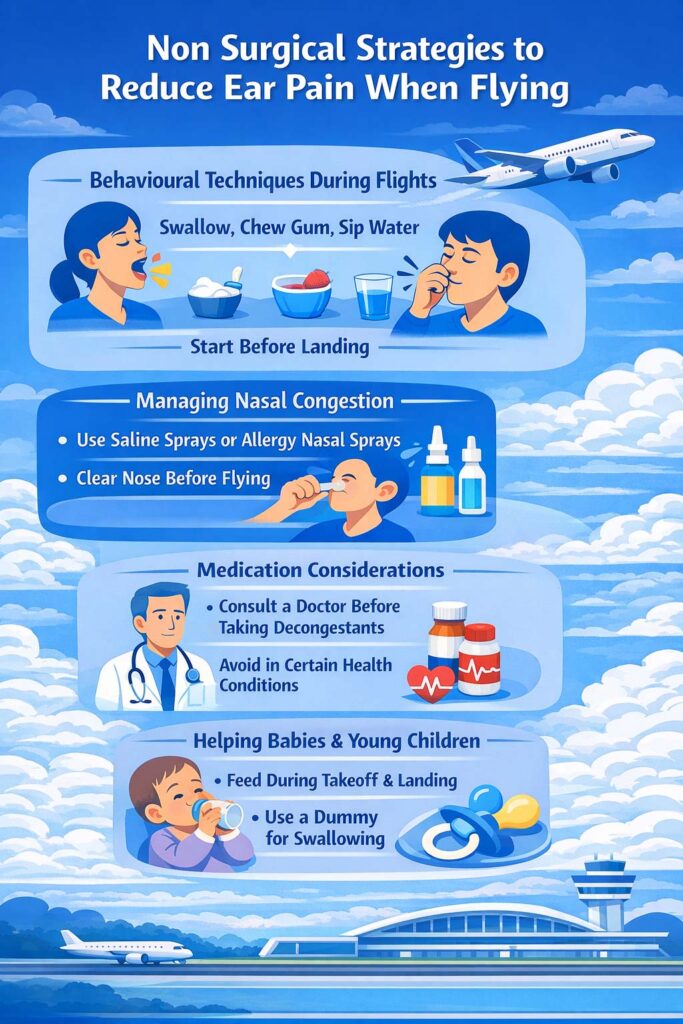
Many people can improve comfort with simple techniques. Swallowing frequently during ascent and descent helps open the Eustachian tubes. Sipping water, sucking on a lolly, or chewing gum are simple ways to do this. Gentle yawning or moving the jaw can help as well.
Some people use a gentle pressure equalising method by pinching the nose, keeping the mouth closed, and blowing carefully until a soft pop is felt in the ears. It is important not to blow too forcefully and to stop if there is pain. It is often helpful to start these techniques about half an hour before landing and to continue until the aircraft is on the ground.
✓ Managing nasal congestion before flying
Keeping the nose as clear as possible reduces the strain on the Eustachian tubes. Saline nasal sprays or rinses can help remove mucus and crusts. For people with hayfever or chronic nasal allergies, using prescribed nasal sprays or antihistamines regularly in the weeks before travel can make a real difference.
For some adults with significant congestion, a doctor may recommend a short course of a nasal decongestant spray around the time of flying. These medicines can open nasal passages but should not be used for long periods and are not suitable for everyone. Following medical advice and avoiding overuse is important.
✓ Medication considerations
In selected adults with a history of severe barotrauma, a GP or ENT specialist may discuss an oral decongestant before flying. This may reduce swelling in the nasal and Eustachian tube lining. However, these medicines are not suitable for people with certain conditions such as uncontrolled high blood pressure or heart disease and should never be started without advice.
In children, medication decisions are more cautious. Parents should always speak with a doctor before giving decongestants or similar medicines for flying. Often, simple measures such as saline sprays and encouraging swallowing are the first line.
✓ Helping babies and young children on flights
For babies and toddlers, feeding during take off and landing is one of the best ways to help. The sucking and swallowing movements naturally open the Eustachian tubes. If age appropriate, a drink from a cup or bottle can also help. A dummy can be useful for children who use one, as long as swallowing is encouraged.
If possible, flying during a high fever or acute ear infection is best avoided, although sometimes travel cannot be delayed. In that case, planning with a GP or ENT specialist in advance can help. When a child repeatedly has severe pain on flights, a thorough ENT assessment with Dr Braham can clarify whether grommets, adenoid surgery, or other treatments may be helpful.
When Might Procedures or Surgery Be Considered
✓ Grommets in children and adults
Grommets are small ventilation tubes inserted into the eardrum to allow air to move freely between the ear canal and middle ear. They are most often used in children with glue ear or recurrent middle ear infections, but in some cases they can also help children or adults with significant barotrauma who do not respond to other measures.
For a child who has ongoing middle ear fluid, frequent infections, and severe pain on flights, grommets can improve everyday hearing and reduce pressure build up on planes. In adults, grommets may be considered if there is chronic Eustachian tube dysfunction or if flying or diving is essential for work and symptoms are severe. The decision to insert grommets is always made after careful assessment and discussion of risks and benefits.
✓ Treating underlying nose and sinus conditions
Treating nose and sinus problems is often central to managing barotrauma. Medical therapies for chronic sinusitis and allergic rhinitis, such as nasal corticosteroid sprays and other prescribed medicines, can reduce inflammation and improve sinus drainage. Better nasal health often translates into better Eustachian tube function.
When medical treatment is not enough, surgery may be considered. Septoplasty to straighten a deviated septum or sinus surgery to open blocked sinuses can improve airflow patterns and reduce congestion. At Melbourne ENT, Dr Simon Braham has significant experience in nasal and sinus surgery and can advise whether these procedures are likely to help reduce your barotrauma risk.
✓ Adenoid surgery in children
In children with enlarged adenoids, adenoidectomy can improve both nasal breathing and Eustachian tube function. It may be recommended for children with recurrent ear infections, persistent glue ear, significant snoring, or obstructed nasal breathing. When a child with these problems also struggles with ear pain on flights, adenoid surgery, sometimes combined with grommets, can improve overall ear health and flight tolerance.
✓ Careful discussion of benefits, risks, alternatives and Medicare
Any surgery carries potential risks as well as benefits. At Melbourne ENT, Dr Braham takes a conservative approach, recommending surgery when non surgical options have not resolved the problem, when symptoms significantly affect quality of life, or when there is a risk of long term complications if nothing is done. Before any procedure, he explains what is involved, what outcomes can reasonably be expected, and what the possible risks and side effects are, so that patients and families can make informed choices.
In Australia, Medicare provides rebates for medically necessary ENT consultations and surgeries performed in both public and private settings. Procedures such as grommet insertion, adenoidectomy, septoplasty, and sinus surgery usually attract Medicare item numbers when they are done to treat defined medical conditions rather than for cosmetic reasons. At Melbourne ENT, patients are given clear information about which Medicare items apply and what out of pocket costs are likely, taking into account private health insurance, hospital choice, and any excess or co payment. Written financial information is provided before surgery so there are no surprises.
Living with Sensitive Ears: Practical Tips for Frequent Flyers
Planning ahead for regular travel
If you know your ears are sensitive, planning is essential. Seeing a GP or ENT specialist such as Dr Braham before major trips gives time to optimise nasal and sinus health, adjust allergy treatment, and create a personalised strategy for flying. This might include using certain sprays before and during the trip, timing flights to avoid the worst of an infection if possible, and knowing exactly what to do if symptoms occur on board.
For people who have recently had ear or sinus surgery, timing of the next flight should always be discussed with the surgeon. There may be recommended waiting periods to reduce the risk of complications.
Work and lifestyle considerations
When flying is part of your job, it can be difficult to avoid travel during periods of illness. However, keeping employers informed about significant health issues can sometimes allow adjustments, such as spacing out flights, avoiding non urgent trips when you are unwell, or planning recovery time after surgery. For people who both dive and fly, close coordination between ENT advice and diving medical recommendations is important.
Emotional and quality of life aspects
Barotrauma is not just a physical issue. Anxiety about pain, fear of damaging the ears, and worries about children suffering on flights can all make travel stressful. Some people begin to dread every descent and may avoid trips they would otherwise enjoy or need to take.
Understanding what is happening in the ear, having a clear plan to reduce risk, and knowing when to seek help can ease much of this worry. For many, addressing underlying ENT problems and having the support of a specialist like Dr Braham transforms flying from a feared experience back into an ordinary part of life.
Why Choose Melbourne ENT and Dr Simon Braham for Ear Pain When Flying
Experience and focus on functional outcomes
Dr Simon Braham is an ENT surgeon who completed his medical degree with honours at Monash University and advanced ENT training in Melbourne. He undertook further training in nasal and facial surgery in New York and Boston and has been practicing in both private and public settings since 2001, including at Masada Private Hospital, the Royal Victorian Eye and Ear Hospital, and Kyneton Hospital.
His clinical interests include paediatric ENT surgery, nasal and sinus surgery, and surgery for snoring and sleep apnoea. Many of the conditions that drive barotrauma, such as Eustachian tube dysfunction, chronic sinusitis, nasal obstruction, and enlarged adenoids, fall within these areas. This experience supports a practical, function focused approach that aims to improve breathing, hearing, and comfort rather than simply treating isolated episodes.
Melbourne ENT’s philosophy of care
Melbourne ENT in St Kilda East serves patients from across Melbourne and regional Victoria. The clinic’s philosophy centres on comprehensive, individualised care that is grounded in evidence and delivered with clear and honest communication. The goal is to understand how ear pain when flying fits into the wider context of a person’s health and lifestyle, then tailor management to suit.
Conservative options and medical treatments are explored carefully. When surgery is considered, it is recommended with clear discussion of benefits, risks, and alternatives. Patients are supported through every stage from assessment to follow up.

FAQs About Ear Pain When Flying and Barotrauma
Can ear barotrauma cause problems that only show up a few days after I land, such as feeling unsteady or hearing a new sound in one ear?
Most people notice ear pressure or pain during or soon after a flight, but some effects can become more noticeable over the next few days. Fluid trapped behind the eardrum may take time to clear and can cause ongoing muffled hearing, fullness, or mild unsteadiness. A new ringing or buzzing sound in one ear, called tinnitus, can also begin after a difficult flight. These symptoms often settle, but if they persist, worsen, or are accompanied by strong vertigo or marked hearing loss, you should see a doctor or ENT specialist so the ears can be examined and inner ear problems excluded.
If one of my ears always hurts more than the other when I fly, does that mean there is something structurally different on that side that needs an ENT check?
It is very common for one ear to be more troublesome than the other. This can reflect small differences in Eustachian tube function, previous infections or scarring, or structural issues such as a deviated septum affecting one side of the nose. It does not always mean a serious problem, but if one sided pain or blockage occurs on most flights, an ENT assessment is sensible. A specialist can look for middle ear fluid, Eustachian tube dysfunction, or nasal causes on that side and suggest targeted treatment to improve future flights.
Is it safer for my ears to stay awake and actively swallow during descent, or can I sleep through landing without increasing my risk of barotrauma?
Staying awake and actively swallowing does give your ears the best chance to equalise pressure smoothly, especially if you are prone to barotrauma. When you are asleep you swallow less often, so the Eustachian tubes may not open frequently enough during the rapid pressure changes of descent. Some people with healthy ears sleep through landing without difficulty, but if you usually wake up with painful, blocked ears, planning to stay awake and using drinks, chewing, or gentle equalising techniques during descent is a safer strategy.
I often get severe sinus congestion but no obvious ear pain on flights. Could I still be getting barotrauma that only shows on examination?
Severe sinus congestion does not always cause clear ear symptoms. In some people, the Eustachian tubes cope reasonably well despite a blocked nose, and they feel little or no pain. However, mild negative pressure in the middle ear or subtle eardrum changes can still occur and may only be seen with examination or tympanometry. If you have frequent sinus problems and are concerned about your ears, an ENT review can clarify whether your middle ears are affected and whether better sinus management could improve your comfort and protect your ears on flights.
After having grommets or other ear surgery, are there specific signs on my next flight that mean I should seek urgent review afterward?
If you have had grommets or other ear surgery, you should follow your surgeon’s guidance on when it is safe to fly. During and after the first flights, you should seek urgent review if you experience sudden severe ear pain that does not settle, any new blood or persistent discharge from the ear, a significant drop in hearing, or strong spinning dizziness and nausea. These signs do not automatically mean something serious has happened, but they do mean the ear should be examined promptly. It is always better to discuss plans for flying with your surgeon ahead of time, especially soon after an operation.
My child has speech delay and frequent ear infections and also screams during landing. How do I know if flying is making their underlying ear condition worse?
In a child with speech delay and frequent ear infections, there is often ongoing middle ear fluid or Eustachian tube dysfunction that affects hearing day to day as well as on flights. Flying can temporarily worsen pain and draw attention to the problem, but the bigger concern is usually the constant impact of reduced hearing on speech and learning. If your child screams during landing and also has delayed speech or difficulties at school, an ENT assessment with hearing tests is very important. Treating the underlying ear condition, for example with grommets or adenoid surgery when appropriate, can improve both everyday hearing and their ability to tolerate flights.
If I have had one very bad episode of barotrauma with fluid or blood in the ear, does that permanently change how my ears handle pressure in the future?
A severe episode of barotrauma can be alarming, especially if there is fluid or blood in the middle ear or a small tear in the eardrum. In many people, the ear heals well and pressure handling returns close to normal. However, that episode does show that under certain conditions, such as flying with a heavy cold, your Eustachian tubes struggled to cope. It is wise to treat it as a warning sign. An ENT specialist can check how well the ear has healed, look for any scarring, and help you plan for future flights by optimising nasal and sinus health, advising on the timing of travel when you are unwell, and considering further options if pressure problems remain severe.
Medical References
- Barotrauma – StatPearls / NCBI Bookshelf – NIH / https://www.ncbi.nlm.nih.gov/books/NBK482348/
- Pulmonary Barotrauma / NCBI Bookshelf – NIH / https://www.ncbi.nlm.nih.gov/books/NBK559293/
- Ear Barotrauma / NCBI Bookshelf – NIH / https://www.ncbi.nlm.nih.gov/books/NBK499851/
- Outcomes of Barotrauma in Critically Ill COVID-19 Patients With Severe Pneumonia / PMC – NIH / https://pmc.ncbi.nlm.nih.gov/articles/PMC8221250/
- Barotrauma and its complications in COVID-19 patients / PMC – NIH / https://pmc.ncbi.nlm.nih.gov/articles/PMC9284477/
- Barotrauma and pneumothorax / PMC – NIH / https://pmc.ncbi.nlm.nih.gov/articles/PMC4332090/
- The Predictive Power of Barotrauma from the Macklin Effect / PMC – NIH / https://pmc.ncbi.nlm.nih.gov/articles/PMC12523701/
Key Messages and Next Steps
Key points for patients to remember
Ear pain when flying is usually caused by pressure changes in the middle ear rather than by a new infection. This pressure problem, called barotrauma, can range from mild, brief discomfort to more serious injury with eardrum tears or inner ear involvement. Children are particularly prone because their Eustachian tubes are smaller and more easily blocked.
Many people can reduce symptoms by swallowing and yawning during flights, managing nasal congestion before travel, and planning around periods of illness. Treating underlying conditions such as sinusitis, allergic rhinitis, nasal obstruction, or adenoid enlargement can further improve comfort and reduce the chance of problems.
Encouraging patients to seek appropriate help
If you live in Melbourne or regional Victoria and avoid flights because of ear pain, if your ears remain blocked for days after travel, or if your child regularly becomes very distressed during descent, it is reasonable to seek professional advice. A GP can provide an initial assessment, and if problems are persistent or complex, a referral to Dr Simon Braham at Melbourne ENT can provide more detailed investigation and an individualised management plan.
Taking the Next Step with Melbourne ENT
If you are concerned about ear pain when flying or the effects of barotrauma and would like a specialist opinion, you can contact Melbourne ENT in St Kilda East to arrange a consultation with Dr Simon Braham. To learn more about the services offered or to organise an appointment, please call the rooms or visit related pages on this website to learn more.
Further Reading
- Read more about Ear Ache Melbourne
- Read more about Glue Ear (Grommets)
- Read more about Middle Ear Infection (AOM)
- Read more about Sudden Hearing Loss – An Otologic Emergency
- Read Melbourne ENT Blog about Middle Ear Aeration Methods: How Can They Help?
- Read Melbourne ENT Blog about What is Otitis Externa? (Swimmer’s Ear)