


Melbourne ENT, located in the heart of St Kilda East, Victoria, is one of Melbourne’s leading specialist centres for the diagnosis and treatment of ear, nose, and throat (ENT) conditions. Led by the highly qualified and experienced surgeons Dr Stephen Kleid and Dr Simon Braham, the clinic provides comprehensive and compassionate care across all ENT disciplines. Whether addressing breathing issues, cosmetic nasal concerns, or head and neck tumours, our approach is grounded in surgical excellence and personalised patient care.
Among the many conditions we treat, a broken nose is one that requires timely evaluation and, in many cases, urgent intervention. A nasal fracture can significantly impact both appearance and function, and if left untreated, it may lead to long-term complications.
At Melbourne ENT, we combine decades of experience with state-of-the-art diagnostic tools and surgical precision to ensure patients receive the highest standard of care when dealing with nasal trauma.
What Is A Broken Nose?
A broken nose, medically referred to as a nasal fracture, occurs when the bones or cartilage of the nose are cracked, displaced, or shattered due to trauma. The nose is a central and prominent facial feature, making it particularly vulnerable to injury. Common causes include falls, contact sports, motor vehicle accidents, and physical altercations.
The severity of nasal fractures can vary widely, from mild injuries with minor swelling to significant disfigurement and nasal obstruction that require immediate surgical correction. While some nasal fractures may seem superficial, even subtle injuries can affect breathing by altering the structure of the nasal septum or blocking the internal nasal valves.
It is important to understand that a broken nose is not always just a cosmetic concern – it can be a functional emergency. Prompt assessment is essential to determine whether conservative management will suffice or if surgical intervention is needed to restore the normal alignment, structure, and airflow through the nasal passages.
Common Symptoms Of A Broken Nose
Patients who have sustained a nasal injury often present with a combination of visible, physical, and functional symptoms. Typically, there is noticeable swelling across the nose and surrounding facial areas, particularly beneath the eyes. Many patients report acute pain that is exacerbated by touching or attempting to move the nose.
Nasal bleeding is also a common initial symptom and can range from mild to profuse. Bruising, especially around the eyes, often develops within a few hours of the trauma. In more severe cases, patients may notice an obvious shift or deviation in the shape of their nose, indicating a displaced fracture. Internally, breathing may become impaired due to swelling or structural disruption, leading to a sense of blockage in one or both nostrils. Some patients also experience a loss or alteration of their sense of smell.
Another concerning sign is the presence of a septal haematoma – a collection of blood inside the nasal septum – which may not be visible externally but can cause significant internal damage if not treated urgently.
Who Is Affected By A Broken Nose?
Nasal fractures can happen to anyone, but certain groups are more commonly impacted due to lifestyle, activities, or anatomical predispositions. Active individuals, especially those involved in contact sports such as football, rugby, boxing, or martial arts, are at higher risk of sustaining nasal trauma. Young adults and adolescents are also more susceptible due to their participation in high-energy activities and sports.
In elderly patients, a fall at home or in public can easily result in facial injuries, including nasal fractures, particularly when bone density is reduced. Children, while more flexible in some respects, can suffer cartilage damage that may affect facial growth if left untreated. Those with previous nasal surgery or existing anatomical irregularities, such as a deviated septum, may also be more prone to nasal injury or more likely to suffer functional complications from a fracture.
It is also worth noting that individuals in occupations with a higher risk of physical confrontation, such as police officers, security personnel, and emergency responders, may experience nasal trauma more frequently.
Diagnosis And Evaluation At Melbourne ENT
The treatment of a fractured nose is considered a surgical emergency because if it is not treated in a timely manner the results may be poor. The fracture should be seen within the first week of injury.
The evaluation of a broken nose at Melbourne ENT begins with a comprehensive clinical assessment designed to accurately determine the extent of the injury and the most appropriate course of action. During the initial consultation, our specialists will discuss the circumstances of the injury, the timing, and any immediate symptoms the patient may have noticed, such as changes in appearance, breathing difficulty, or bleeding.
A physical examination follows, which includes gentle palpation of the nasal bones and inspection of the external and internal nasal structures. If internal bleeding or swelling is suspected, particularly a septal haematoma, a more detailed examination using a nasal speculum or fibre-optic endoscope may be performed. This allows our surgeons to visualise the internal nasal cavity with precision.
In cases where complex fractures or additional facial injuries are suspected, imaging studies such as a CT scan or facial X-rays may be recommended. These investigations help determine whether the fracture involves other bones of the face or sinuses, and whether surgical intervention is necessary. Our goal is to provide an accurate, swift diagnosis that ensures the best chance of full functional and aesthetic recovery.
Treatment Options For A Broken Nose
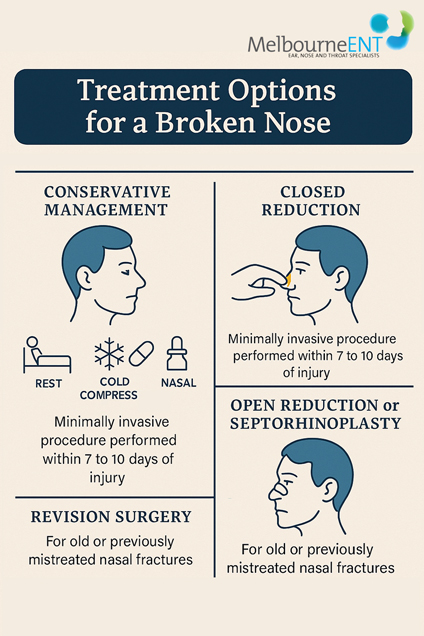
Treatment for a broken nose varies based on the severity of the fracture, the degree of displacement, the patient’s symptoms, and how much time has passed since the injury occurred. It’s important to remember that surgery must be performed in a timely manner and if delayed the bones will set and the deformity will be permanent.
For minor fractures where the bones remain aligned and the nasal airway is not obstructed, conservative management may be sufficient. This includes rest, cold compresses, pain relief, and nasal decongestants to manage swelling and discomfort.
However, when the fracture is more pronounced or results in a visible deformity or breathing obstruction, surgical options become necessary. At Melbourne ENT, our surgeons are skilled in both closed and open nasal reductions. Closed reduction is a minimally invasive procedure performed within 7 to 10 days of the injury, while the bones are still mobile. It involves manual realignment of the nasal bones and often provides excellent functional and cosmetic outcomes.
For more complex or delayed cases, open reduction or septorhinoplasty may be required. These procedures address not only the fracture but also any septal deviation, cartilage damage, or cosmetic irregularity that may have resulted from the injury. Our team also provides revision surgery for patients with old or previously mistreated nasal fractures that continue to cause breathing or aesthetic concerns.
When Is Surgery Recommended?
Surgical intervention is generally recommended when the nasal bones are visibly displaced, when there is a loss of nasal symmetry, or when patients experience significant obstruction of airflow. Additional indicators include a persistent septal haematoma, chronic nasal congestion following trauma.
For patients whose injury wasn’t treated in a timely manner and has led to a collapse or asymmetry of the nasal tip or bridge, rhinoplasty or reconstructive nasal surgery may be advised. These problems are much more difficult to fix.
At Melbourne ENT, surgery is also considered for individuals with previous untreated fractures who are dissatisfied with the appearance of their nose or have developed secondary breathing difficulties. Timely surgical intervention, ideally within 10 days of the trauma, is associated with the best results. However, even older injuries can be successfully treated with a more structured approach involving cartilage grafting and full nasal reconstruction if necessary.
Our surgeons consider not just the mechanics of the nose but also the patient’s facial symmetry, aesthetic preferences, and long-term functional needs.
Recovery And Prognosis
Recovery from a broken nose, whether managed conservatively or surgically, varies depending on the extent of the injury and the treatment method chosen.
For those treated without surgery, symptoms typically subside within a week or two, and the swelling resolves without long-term issues. Patients undergoing closed reduction may experience mild discomfort for a few days and typically return to normal activities within a week, although contact sports should be avoided for at least six weeks.
Like any broken bone it will take 6 weeks for the fracture healing to be strong. When more extensive surgery such as open rhinoplasty or septoplasty is performed, recovery includes a period of rest, the use of nasal splints or external tapes, and follow-up care to monitor healing.
Swelling may persist for several weeks, but most patients begin to see the final shape and functional outcome within two to three months, with complete resolution by six to twelve months. At Melbourne ENT, patients are provided with detailed aftercare instructions and regular follow-up appointments to ensure optimal healing.
With proper care, the prognosis for a broken nose is excellent, and most patients experience full restoration of nasal function and appearance.
Risks Or Complications If Left Untreated
Neglecting a broken nose or delaying its treatment can lead to a range of complications. One of the most immediate risks is the development of a septal haematoma, which if untreated, can lead to cartilage death and permanent deformity.
Over time, untreated fractures may cause chronic nasal obstruction, leading to mouth breathing, snoring, and poor sleep quality. Aesthetic deformities such as a crooked nose, a flattened bridge, or a collapsed tip can also develop, affecting facial harmony. In some cases, structural abnormalities resulting from an untreated fracture may predispose patients to recurrent sinus infections due to impaired drainage.
There is also the risk of chronic nosebleeds, altered sense of smell, and nasal valve collapse. Early evaluation and treatment are key to preventing these outcomes and ensuring the nose heals in both form and function.
Why Choose Your Surgeon
Choosing the right specialist is crucial when it comes to managing a broken nose. At Melbourne ENT, patients benefit from the care of two of Melbourne’s most respected ENT surgeons.
Dr Stephen Kleid brings decades of surgical experience, particularly in complex nasal and head and neck procedures. His approach is thorough and evidence-based, drawing on years of work in both public and private hospital systems, including leadership roles at institutions like Peter MacCallum Cancer Centre.
Dr Simon Braham offers extensive training in ENT with an emphasis on nasal surgery, allowing him to combine functional improvements with outstanding cosmetic results. With broad experience in adult and paediatric ENT, Dr Braham is known for his patient-centred approach and excellent outcomes. Both surgeons are Fellows of the Royal Australasian College of Surgeons and bring the highest level of surgical skill, diagnostic accuracy, and ethical patient care to every case.
FAQs About Broken Nose
Can a broken nose heal itself if left alone without intervention?
In some cases, a broken nose can heal without medical intervention if the fracture is non-displaced and does not impair breathing. However, without proper assessment, there is a risk of the bones healing in a misaligned position, leading to long-term cosmetic or functional issues.
What is the ideal timeframe to seek treatment for a nasal fracture before bones set incorrectly?
It is recommended to seek evaluation within 7 days after the injury. This window allows swelling to subside and provides the best opportunity for realignment before the bones begin to set.
Are there non-visible complications of a broken nose that patients should be aware of?
Yes, complications such as septal haematoma, internal scarring, and nasal valve collapse may not be externally visible but can severely affect breathing and long-term nasal function if not addressed promptly.
How does a past nasal fracture affect future surgeries or breathing?
Previous nasal trauma can create scar tissue, septal deviations, or cartilage damage, which may complicate future surgeries and contribute to chronic nasal obstruction. A thorough assessment helps in planning revision procedures if necessary.
Can a broken nose impact the sinuses or lead to chronic nasal issues?
Yes, a nasal fracture can alter the anatomy of the nasal passages and sinuses, leading to poor drainage, recurring sinus infections, and chronic congestion if left untreated.
What are the signs that a broken nose is affecting your sleep or causing undiagnosed snoring?
Signs include persistent mouth breathing during sleep, loud snoring, dry mouth upon waking, and daytime fatigue. These may indicate airway obstruction from a deviated septum or narrowed nasal valves due to the fracture.
Is it possible for a broken nose to cause subtle but progressive changes in facial symmetry over time?
Yes, even a slightly misaligned nasal fracture can affect the balance of the face. Over time, this can lead to noticeable asymmetry, particularly in the nasal bridge, tip, or alignment with the lips and chin.
Sources:
- Epidemiology, surgical intervention and management of nasal fractures – International Journal of Research in Medical Sciences
https://www.msjonline.org/index.php/ijrms/article/download/13376/8691/62233 - Management of Acute Nasal Fractures – American Academy of Family Physicians (AAFP)
https://www.aafp.org/pubs/afp/issues/2004/1001/p1315.html - Nasal Fracture Reduction – StatPearls, NCBI Bookshelf
https://www.ncbi.nlm.nih.gov/books/NBK538299/ - Acute Management of Nasal Bone Fractures: A Systematic Review – The American Surgeon, SAGE Journals
https://journals.sagepub.com/doi/10.1177/00031348251358429 - Clinical Characteristics of Nasal Fractures: An 11-year Retrospective Study – PMC, NCBI
https://pmc.ncbi.nlm.nih.gov/articles/PMC12151707/ - Management of Nasal Fractures – Herald Scholarly Open Access
https://www.heraldopenaccess.us/openaccess/management-of-nasal-fractures - Comparative Analysis of Open and Closed Nasal Fractures – MDPI
https://www.mdpi.com/1943-3883/18/1/9
Concerned About A Broken Nose?
If you or someone you know has suffered a nasal injury, timely evaluation by an ENT specialist can make all the difference. A broken nose is not only a cosmetic issue – it can have serious implications for breathing, sleep, and long-term facial structure. At Melbourne ENT, we are here to guide you through diagnosis, treatment, and recovery with precision and care. Do not delay. Contact our team to arrange a consultation and start your journey toward restored function and breathing. For expert care, reach out to Dr Stephen Kleid on (03) 9038 1630 or visit the website. To book an appointment with Dr Simon Braham, call (03) 9038 1311.
Further Reading
- Read about Melbourne ENT’s Nose Concerns and Conditions
- Read about Melbourne ENT’s Rhinoplasty Melbourne – Nose Reshaping Surgery
- Read about Melbourne ENT’s Revision Rhinoplasty
- Read about Melbourne ENT’s Alarplasty Melbourne – Alar Base Reduction
- Read about Melbourne ENT’s Nostril Sill Reduction Melbourne