


Introduction: School Holidays, Sore Throats and Timing
School holidays in Melbourne often mean later nights, travel, more socialising and more time indoors during cooler months. It is very common for children, teenagers and adults to pick up colds and minor infections during this time. A sore throat here and there is expected. The problem arises when sore throats keep occurring or seem to drag on for weeks at a time.
When life is busy during the school term, many families simply keep going and hope things will improve on their own. Holidays are often the first time parents pause and realise just how often their child has been sick, or how many days of work they have lost themselves. This holiday pause is exactly when it can help to seek timely assessment instead of waiting until school resumes.
Melbourne ENT, based in St Kilda East, is a specialist ear, nose and throat clinic caring for patients from across Melbourne and regional Victoria. The practice of Dr Stephen Kleid, ENT and Head & Neck Surgeon, and Dr Simon Braham, ENT Surgeon, provides careful assessment and treatment for adults and children with recurrent sore throats, tonsillitis and related conditions.
Understanding Recurrent Sore Throats
✓ What Counts as a Recurrent Sore Throat
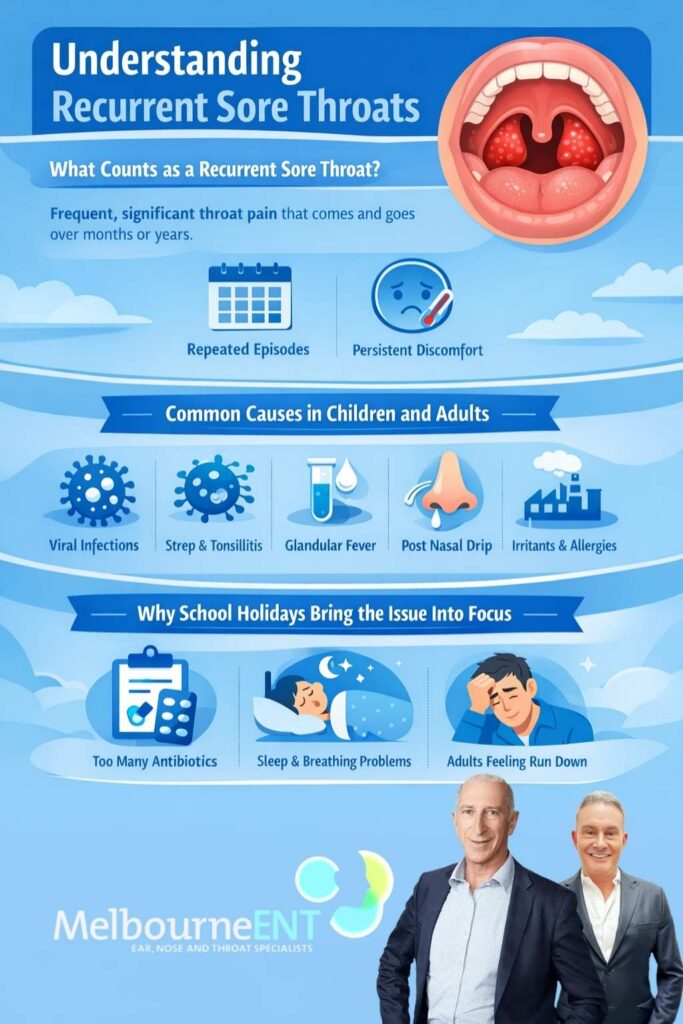
Most people will experience the occasional sore throat with a cold or flu. A recurrent sore throat is different. The term usually refers to repeated episodes of significant throat pain over months or years, or a pattern where the throat seems to settle for a short time and then flares again.
Some families notice several episodes each school term, often accompanied by fever, swollen glands or the need for antibiotics. Others report that the sore throat never really goes away, with only brief periods of relief. Even if each episode feels minor on its own, the overall pattern can have a large effect on sleep, mood, work and school life. When that pattern becomes obvious during the holidays, it is a good time to seek advice.
✓ Common Causes in Children and Adults
In both children and adults, recurrent sore throats can have many possible causes. Viral infections are very common and can affect the tonsils and the back of the throat. Bacterial infections, including strep throat and recurrent tonsillitis, may require careful assessment and sometimes antibiotic treatment. Glandular fever can cause prolonged throat pain, fatigue and swollen glands, particularly in teenagers and young adults.
Other contributors may include nasal allergies with post nasal drip, stomach acid reflux that irritates the throat, and environmental factors such as smoke or very dry air. In adults, voice strain or irritants at work can also play a role. An ENT specialist such as Dr Stephen Kleid or Dr Simon Braham will consider these possibilities when assessing recurrent symptoms and will tailor the assessment to the age and situation of each patient.
✓ Why School Holidays Bring the Issue Into Focus
During the school term, it is easy to move from one week to the next without looking at the bigger picture. A child misses a day here and there, parents rearrange work and sport, and everyone hopes the next term will be better. Adults often use their voice all day and accept a sore throat as part of the job.
School holidays provide breathing space. Parents may suddenly realise how many times their child has been on antibiotics, how often they have snored or struggled to breathe at night, or how tired and irritable they seem. Adults, including teachers and carers, may notice that their own sore throats feel worse when they finally stop. This pause is an opportunity to act rather than wait for another busy term to begin.
How Recurrent Sore Throats Affect Daily Life
✓ Children and School Aged Students
For school aged children, recurrent sore throats can affect far more than just comfort. Painful throats often lead to disrupted sleep, particularly when enlarged tonsils cause snoring or breathing pauses overnight. A tired child may struggle to concentrate, become irritable, or fall behind at school.
Frequent infections can also mean repeated absences from class, sport and social activities. Parents may feel as though their child is always sick or trying to catch up. Over time, this can impact learning, friendships and confidence. When families from Melbourne and surrounding areas talk to the team at Melbourne ENT, they often describe a pattern of disruption rather than a single severe episode.
✓ Teenagers and Young Adults
Teenagers and young adults may be juggling school, exams, part time work and sport. Recurrent sore throats can make it difficult to keep up with these demands. A persistent cycle of infection, fatigue and poor sleep can lead to reduced exercise tolerance, frequent days off and a general feeling of being unwell.
This age group may also experience glandular fever, which can cause prolonged throat pain and tiredness. Many young people try to push through rather than seek help, especially during busy school terms. The holiday period can be a better time to step back, reflect and consider specialist assessment if problems have been frequent or long lasting.
✓ Adults, Parents and Teachers
Adults, including parents, carers and teachers, often place their own health last. It is common to ignore recurrent sore throats during term time, especially when work involves constant talking or caring for children. Over time, ongoing throat discomfort can affect job performance, voice quality, attendance and general wellbeing.
Teachers and childcare workers in Melbourne are frequently exposed to infections and may report repeated bouts of sore throat that never quite resolve. Parents caring for young children may also notice they seem to catch every virus that comes through the house. When both adults and children in a family are affected, the overall impact can be significant. Seeking timely assessment during the holidays can help break this cycle and plan ahead for the next term.
When a Sore Throat Is More Than Just a Virus
✓ Frequency, Severity and Duration
A single mild sore throat that settles within a few days is usually not a cause for concern. Patterns of frequency, severity and duration are more important. Several episodes of high fever and severe throat pain each term, or infections that take many days to resolve, may signal a need for further review.
Some children experience repeated episodes that are clearly documented as tonsillitis, with enlarged, inflamed tonsils and significant pain. Others have symptoms that blur together, with one infection following another. Adults may describe constant low level throat discomfort interspersed with more intense episodes. When these patterns continue over months or years, it is reasonable to discuss them with a GP and consider whether referral to Melbourne ENT is appropriate.
✓ Signs of Complications
While many sore throats are uncomplicated, there are warning signs that suggest something more serious. Intense pain on one side of the throat, difficulty swallowing, a muffled or so called hot potato voice, or significant neck swelling can indicate a deep infection near the tonsil or in the tissues of the neck. This can sometimes develop into a condition called peritonsillar abscess, which usually requires urgent medical attention.
Other concerning features include very high fevers, difficulty opening the mouth, or feeling very unwell despite simple treatment. These symptoms should not be watched at home over the holidays. Instead, urgent review by a GP or hospital emergency department is important, whether you are in inner Melbourne or travelling elsewhere in Victoria.
✓ Persistent Symptoms in Adults
Persistent throat symptoms in adults deserve particular attention. Throat discomfort, a sensation of something stuck, difficulty swallowing or voice changes that last for several weeks should be medically reviewed. This is especially important in adults who smoke, have significant alcohol intake, or whose work involves constant voice use.
In most cases, the cause will be benign, such as reflux, allergy or muscle tension. However, ongoing symptoms can occasionally be a sign of a more serious problem in the throat or voice box. An ENT assessment with a specialist such as Dr Stephen Kleid or Dr Simon Braham can provide a detailed examination, sometimes including a fine camera, to clarify what is happening and guide appropriate treatment.
Why School Holidays Are a Good Time for Assessment
✓ Less Disruption to School and Work in Melbourne
Arranging medical appointments during the school term can be challenging. Children miss class, parents juggle work, and students worry about missing lessons or exams. During the school holidays, there is often more flexibility. Families can attend GP and specialist appointments without the same pressure on attendance and performance.
For some patients, treatment such as tonsil surgery may be discussed. Recovery after tonsillectomy can take up to two weeks, especially for older children and adults. Scheduling surgery during a holiday period can reduce disruption to school or work. It can also allow parents in Melbourne and regional areas to plan time off and support in advance.
✓ Time to Reflect and Plan
The break from everyday routines allows families to reflect on the past term or year. Parents may look back at school reports, absence notes and medical records and realise how frequent the infections have been. Keeping a simple sore throat diary over the holidays, noting dates, symptoms, medications and time off, can be very helpful when meeting with a GP or ENT specialist.
Holiday time also allows space for calm discussion. Decisions about investigations or surgery rarely need to be rushed. Instead, parents and older children can talk through the options, ask questions and prepare for next steps in a more relaxed setting, guided by clear information from their treating doctors.
✓ Local Context: Melbourne and Surrounding Areas
Melbourne is well served by both public and private hospitals, including Royal Melbourne Hospital and the Royal Victorian Eye and Ear Hospital. Many ENT surgeons have trained and worked in these centres before moving into private practice. Dr Stephen Kleid and Dr Simon Braham have long standing experience in public and private settings across Melbourne, which informs their current work at Melbourne ENT in St Kilda East.
Families from regional Victoria may choose to travel to Melbourne for specialist assessment and surgery. Planning this during a school holiday period can make travel, accommodation and support easier to organise, particularly when siblings are involved. The team at Melbourne ENT is accustomed to working with families from both metropolitan and regional communities and understands the practical realities involved.
What Happens at an ENT Assessment With Melbourne ENT
✓ The Initial Consultation
An initial consultation at Melbourne ENT is designed to be thorough but approachable. The surgeon will take a detailed history, asking about how often sore throats occur, how long they last and how severe they feel. They will also explore any associated symptoms, such as fever, snoring, breathing pauses at night, changes in voice or difficulty swallowing.
Parents are encouraged to bring any notes from previous GP visits or hospital presentations, including information about antibiotics or other treatments given. For adults, work demands, voice use, smoking history and general health are also important. By building a clear picture of the pattern over time, Dr Kleid or Dr Braham can better understand whether the problem is mild, moderate or severe.
✓ Examination and Possible Tests
After talking through the history, the surgeon will gently examine the throat, tonsils, mouth and neck. They may look at the nasal passages and ears as well, since issues in these areas can contribute to throat discomfort. In some adults, particularly those with persistent symptoms, a slim flexible camera may be used to examine the throat and voice box in more detail. This is usually a quick procedure performed in the consulting room with local anaesthetic spray.
Occasionally, further tests may be suggested, such as blood tests, sleep studies or imaging, depending on the individual situation. The aim is not to order unnecessary investigations but to gather enough information to make a careful, evidence based recommendation that fits the person sitting in front of the surgeon.
✓ Collaborative Decision Making
Once the assessment is complete, the surgeon will explain the findings in clear, accessible language. They will discuss what is likely to be causing the symptoms and outline the full range of management options. For many patients, this will include non surgical strategies and careful monitoring. For others, especially those with frequent documented infections or significant sleep disturbance, tonsil surgery may be one of the options discussed.
Melbourne ENT places strong emphasis on collaborative decision making. This means that the advantages and disadvantages of each option are explained, questions are encouraged and there is time to consider what feels right for the patient and family. The goal is not to push surgery, but to offer an individualised plan that balances symptom burden, long term health and the risks and recovery involved in any procedure.
Treatment Options for Recurrent Sore Throats
✓ Non Surgical Management
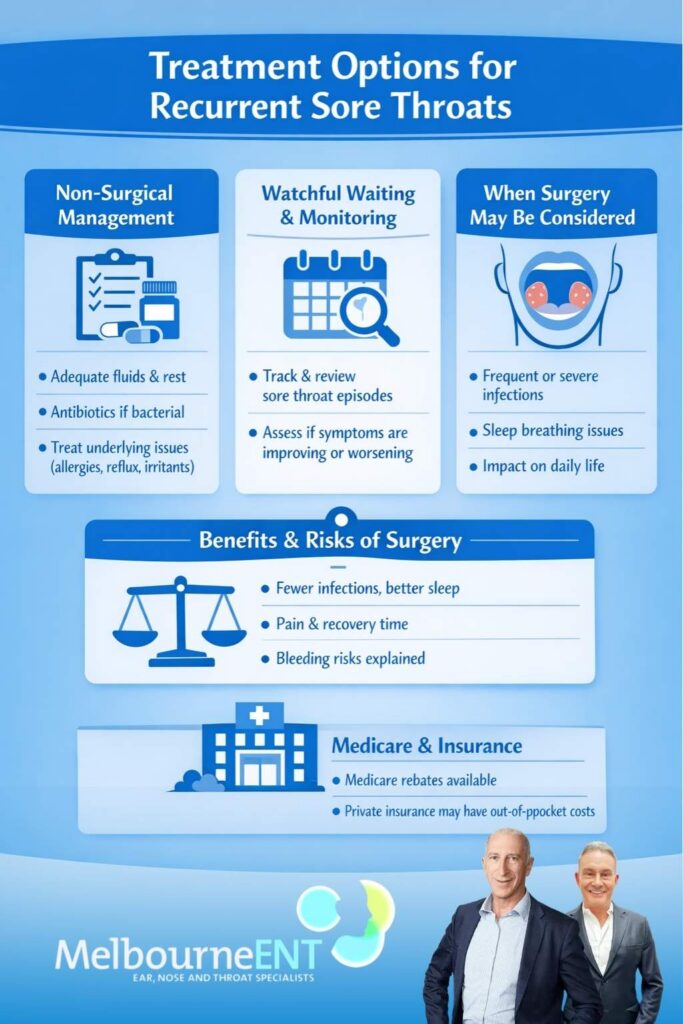
Many recurrent sore throat problems can be managed without surgery. Simple measures such as adequate fluids, rest and appropriate pain relief can make a big difference during an acute infection. Your GP may decide that antibiotics are needed when bacterial infection is suspected, based on symptoms and examination. In other cases, a viral cause may be more likely and antibiotics may not be helpful.
Addressing underlying factors can also be important. For some patients, managing nasal allergies, treating reflux, avoiding smoke exposure or adjusting voice use may reduce throat symptoms. Dr Stephen Kleid and Dr Simon Braham work closely with GPs and other health professionals to ensure that these aspects are considered before surgery is recommended.
✓ Watchful Waiting and Monitoring
In mild or infrequent cases, a watchful waiting approach can be appropriate. This means continuing to monitor episodes, treating each infection carefully and seeking review if patterns change or symptoms worsen. Keeping a record of episodes helps clarify whether the problem is stabilising or becoming more frequent.
For children who have had a cluster of infections within one year but then improve, surgery may not be necessary. For others, particularly where episodes remain frequent and severe, the balance may shift toward considering an operation. These decisions are always made on a case by case basis.
✓ When Throat Surgery or Tonsillectomy May Be Discussed
Tonsillectomy is usually considered for patients who have frequent, significant tonsil infections over a period of time, or who have large tonsils causing sleep disordered breathing. In both children and adults, the main goals of surgery are to reduce the number of severe infections, improve sleep quality and lessen the overall impact on daily life.
When Dr Kleid or Dr Braham discuss surgery, they take into account the number of infections, the severity of each episode, the impact on school or work, and any complications that have occurred. Age, general health and personal preferences are also key factors. For some adults, particularly those in voice heavy occupations, surgery can significantly reduce the burden of recurrent tonsillitis. For others, non surgical management may be more appropriate, and this is explained openly.
✓ Benefits, Risks and Recovery in Balanced Terms
It is important to understand that tonsillectomy is a major operation. For the right patient, it can bring benefits such as fewer severe sore throats and better sleep. However, these benefits cannot be guaranteed for every individual, and improvements are often most noticeable in those with very frequent or severe illness before surgery.
Risks include pain, which can be significant for one to two weeks, difficulty eating and drinking in the early days, infection and bleeding. A small proportion of patients experience bleeding that requires return to hospital or further procedures. Recovery tends to be slower in older teenagers and adults compared with young children. These points are always discussed in detail during consultation at Melbourne ENT so that families and patients can make informed decisions.
✓ Medicare Coverage and Private Health Insurance
In Australia, Medicare provides a rebate for medically indicated tonsillectomy and related throat surgery when the procedure is performed by a specialist surgeon. This rebate covers part of the surgeon’s fee and contributes to the anaesthetist’s fee as well. If surgery is performed as a private patient in a private hospital, there may still be out of pocket costs, sometimes called a gap, depending on the surgeon’s fees and the level of any private health insurance. Hospital charges, such as theatre and accommodation fees, are often covered partly or fully by private health insurance according to the policy, while public hospital surgery, when available, is generally funded differently. At Melbourne ENT, patients are given a clear written estimate of fees, expected Medicare rebates and likely gaps before booking surgery, so there are no financial surprises and families can plan ahead.
Planning Possible Surgery Around School Holidays
✓ Choosing the Right Timing
If surgery is recommended and a family decides to proceed, timing becomes very important. Many parents prefer to schedule tonsillectomy during school holidays so that their child does not miss additional class time. Older students and adults may also find it easier to plan around holidays or quieter work periods.
The surgeons at Melbourne ENT will discuss timing options, taking into account the likely length of recovery and any upcoming events such as exams, performances or major family commitments. While emergencies sometimes arise, most tonsil surgeries can be scheduled in a planned manner to reduce disruption as much as possible.
✓ The Days Before Surgery
In the days leading up to surgery, families receive clear instructions about fasting, medications and what to expect on the day. Children and adults are usually advised when to stop eating and drinking before the operation and which regular medicines should be continued or paused.
This is also a time to prepare emotionally and practically. Talking children through what will happen in age appropriate language can reduce anxiety. Organising time off work, arranging help with siblings and stocking the house with suitable foods and pain relief are all part of making recovery smoother. The team at Melbourne ENT encourages questions at this stage so that everyone feels as informed and supported as possible.
✓ Recovery at Home During the Holidays
Recovery after tonsillectomy can be challenging, especially for older children, teenagers and adults. Pain is usually worst in the first few days and can fluctuate over one to two weeks. Eating and drinking may be uncomfortable at first but remain very important for healing and hydration. Having surgery during the school holidays allows time to rest at home without the pressure of returning quickly to class or work.
Quiet activities such as reading, drawing, board games or gentle screen time can help pass the time during recovery. Parents are given information about signs that require medical review, such as increasing pain not relieved by medication, difficulty drinking enough fluids, or any bleeding from the mouth or nose. Planning surgery during a holiday period can make it easier to focus on recovery and reduce the stress of juggling school and work at the same time.
Caring for Sore Throats at Home During the Holidays
✓ Symptom Relief for Mild Infections
Not every sore throat requires specialist care or surgery. For mild infections, simple supportive care at home is often enough. Drinking plenty of fluids, resting, using appropriate pain relief as advised by a GP or pharmacist, and avoiding smoke can all help. Warm or cool drinks, ice blocks and soft foods may ease discomfort.
Parents and adults should always follow dosing instructions for medicines and check with a health professional if unsure. If symptoms worsen, last longer than expected, or are accompanied by concerning features such as high fever or breathing difficulty, medical review is important, even if it is during a holiday period when routines are relaxed.
✓ When to See Your GP
Your GP is usually the first point of contact for recurrent sore throats. It is sensible to book a review if infections are happening frequently, if symptoms are lasting longer than a week, or if they are causing significant disruption to sleep, school, work or family life. The GP can examine the throat and neck, consider whether tests or antibiotics are appropriate and rule out more serious conditions.
If a pattern of recurrent tonsillitis, sleep disordered breathing or persistent throat symptoms is identified, the GP may recommend referral to Melbourne ENT for further assessment. Working in partnership with local GPs across Melbourne and Victoria, the surgeons at Melbourne ENT aim to provide specialist input when it is most likely to be useful.
✓ Keeping Track of Episodes
A simple record of sore throat episodes can be surprisingly powerful. Noting the date of each infection, the symptoms, any fever, time off school or work, and medications used can make patterns much clearer. Many parents bring a notebook or a summary to their consultation at Melbourne ENT, which helps Dr Stephen Kleid and Dr Simon Braham understand the true burden of illness.
For adults, tracking episodes can highlight how frequently work or social activities are affected. This information forms an important part of the discussion about whether to continue with medical management, adopt a watchful waiting approach or consider surgery.
When Urgent Medical Care Is Needed
✓ Red Flag Symptoms in Children and Adults
Some symptoms should prompt urgent medical care rather than waiting for the next available appointment. These include difficulty breathing, noisy breathing at rest, drooling or inability to swallow fluids, severe neck swelling, or a very unwell appearance. Intense throat pain on one side, difficulty opening the mouth or a muffled voice can also be warning signs of a serious infection.
In adults, sudden onset severe throat pain with high fever, or any bleeding from the mouth or throat, should never be ignored. These situations require immediate assessment at an emergency department, regardless of whether it is during term time or school holidays.
✓ What to Do in an Emergency
If any of these red flag symptoms occur, families should seek urgent medical care by attending the nearest emergency department or calling emergency services. In Melbourne, large public hospitals provide emergency care for both children and adults. Private rooms such as Melbourne ENT are not equipped as emergency departments, so serious concerns are best managed in hospitals that can provide immediate resuscitation, imaging and surgery if required.
Once the acute issue is stabilised, follow up with an ENT specialist can be arranged to discuss long term management and prevention of future problems where possible.
How Melbourne ENT Supports Families in Melbourne and Victoria
✓ A Specialist Team Focused on Ear, Nose and Throat Health
Melbourne ENT is a dedicated ear, nose and throat practice located in St Kilda East, caring for adults and children from across Melbourne and regional Victoria. The clinic is led by Dr Stephen Kleid, ENT and Head & Neck Surgeon, and Dr Simon Braham, ENT Surgeon. Both surgeons hold Fellowship of the Royal Australasian College of Surgeons and have extensive experience in ENT and head and neck surgery.
Their backgrounds include many years of work in major hospitals such as Royal Melbourne Hospital and the Royal Victorian Eye and Ear Hospital, as well as long term involvement in teaching and research. This experience supports a careful, evidence based approach to the assessment and management of recurrent sore throats and tonsil disease.
✓ Individualised Care for Children, Teenagers and Adults
Every patient who attends Melbourne ENT is assessed as an individual. The surgeons take into account age, general health, frequency and severity of infections, sleep quality, school or work demands and family preferences. Treatment plans may range from reassurance and simple measures, through to targeted medical therapy or surgery when clearly indicated.
Throughout this process, the focus remains on clear explanations, realistic expectations and shared decision making. Risks and benefits of any procedure are discussed in detail. The aim is to support patients and families in making informed choices that suit their circumstances, rather than offering a one size fits all solution.

FAQs About Recurrent Sore Throats During School Holidays
How can I tell if my child’s sore throat pattern during the year is serious enough to talk about with an ENT specialist rather than just our GP?
If your child has had multiple sore throats with fever, time off school or repeated antibiotics over the year, it is reasonable to ask your GP whether an ENT referral is appropriate. Bringing a simple record of dates, symptoms and treatments helps your GP and, if needed, the team at Melbourne ENT understand how significant the pattern really is. Even if surgery is not required, specialist input can clarify what is going on and how best to manage it.
Is it a problem if my child seems completely well between sore throat episodes, or do recurrent infections still matter if they bounce back quickly each time?
Many children appear well between infections, but frequent episodes can still disrupt sleep, learning and family life. If your child is missing class regularly or needing multiple courses of antibiotics, it is worth discussing this pattern, even if they recover quickly each time. An ENT review can help weigh up whether continued observation or more active treatment is the best approach.
Could my own recurrent sore throats as a parent or teacher be linked to voice strain or workplace irritants, not just infections, and how would an ENT work that out?
In adults, sore throats can certainly be related to heavy voice use, air conditioning, dust, chemicals or smoke, as well as infections. During an assessment, an ENT specialist at Melbourne ENT will ask detailed questions about your work environment and examine your throat and voice box to look for signs of irritation or strain. Sometimes simple changes to voice habits or workplace exposures can make a real difference.
If my child snores or breathes with their mouth open at night but rarely complains of sore throat pain, could their tonsils still be part of the problem?
Yes, large tonsils and adenoids can cause snoring, mouth breathing and disturbed sleep even if a child does not often complain of pain. Parents may notice restless nights, sweating, bed wetting or daytime tiredness instead of obvious sore throat symptoms. An ENT assessment can help determine whether enlarged tonsils or adenoids are contributing to sleep problems and whether surgery or other treatments should be considered.
What are some less obvious signs during the holidays that recurrent sore throats are affecting my child’s learning or behaviour once school returns?
Subtle signs can include difficulty concentrating on holiday reading or games, irritability when tired, or needing much longer to recover from minor illnesses. If you notice that your child seems exhausted after a term of frequent infections, or that they dread catching yet another sore throat, it may be a clue that their health is affecting school performance. Raising these concerns with your GP or an ENT specialist can help everyone plan for a smoother term ahead.
If I book an ENT review during the school holidays and surgery is not recommended, what other practical strategies might still make next term easier for my family?
Even when surgery is not advised, an ENT review can lead to a more targeted plan for the next term. This might include treating allergies, adjusting reflux medication, improving nasal breathing, or agreeing on clear thresholds for when to see the GP or stay home from school. Melbourne ENT can also provide guidance on symptom relief, sleep routines and monitoring, so families feel more prepared rather than simply waiting for the next infection.
How long should I wait to see if a stubborn sore throat settles over the holidays before I start worrying that it might be something more serious that needs specialist assessment?
Most simple viral sore throats begin to improve within a week, even if a cough or runny nose lingers a little longer. If significant throat pain, swallowing difficulty or voice change is still present after two weeks, especially in an adult, it is sensible to see your GP for a closer look. Your GP can then decide whether prompt referral to Melbourne ENT is needed to rule out less common but more serious causes.
Medical References
- Open partial or transoral laryngectomy – total laryngectomy today – https://pmc.ncbi.nlm.nih.gov/articles/PMC12394142/
- Complications Following Lingual Tonsillectomy: Analysis of the National Surgical Quality Improvement Program (NSQIP) Database – https://pmc.ncbi.nlm.nih.gov/articles/PMC12753122/
- Volume and Practice‐Setting Shift of Laryngology Procedures During the COVID‐19 Pandemic: A Reg‐ENT Database Analysis – https://pmc.ncbi.nlm.nih.gov/articles/PMC11000131/
- Current Approaches to Airway and Ventilation Strategies in Laryngotracheal Surgery: A Narrative Review – https://pmc.ncbi.nlm.nih.gov/articles/PMC12734573/
- Utility of concurrent pharyngoplasty with adenotonsillectomy to treat pediatric obstructive sleep apnea – https://pubmed.ncbi.nlm.nih.gov/41037874/
- Remote-Access Thyroidectomy and Parathyroidectomy: A 2025 Consensus Statement – https://pubmed.ncbi.nlm.nih.gov/41173534/
- Current Status of Partial Laryngeal Surgery for Advanced Laryngeal Cancer – https://pubmed.ncbi.nlm.nih.gov/38647994/
Taking the Next Step These School Holidays
If you have noticed a pattern of recurrent sore throats in yourself or your child, it can be helpful to use the school holidays as a time to reflect and seek advice. Rather than hoping things will settle once term starts again, consider speaking with your GP about whether referral to Melbourne ENT for specialist assessment would be appropriate.
The team at Melbourne ENT in St Kilda East is available to assess children, teenagers and adults with recurrent sore throats, tonsillitis and related concerns. For more information about assessment and treatment options with Dr Stephen Kleid and Dr Simon Braham, you can talk to your GP, contact the clinic by phone or using the contact page. This article provides general information only and is not a substitute for personalised medical advice. If you are worried about a sore throat that is severe, persistent or keeps returning, timely assessment instead of waiting until school resumes can make an important difference.
Further Reading
- Read more about Tonsil Stones Melbourne – Also Known As Tonsilloliths
- Read more about Voice and Larynx Disorders
- Read more about Swallowing Issues – Causes and Treatment Options for Dysphagia
- Read Melbourne ENT’s Blog on What is Coblation Tonsillectomy ? – Cold-Ablative Tonsillectomy in Melbourne
- Read Melbourne ENT’s Blog on Snoring Treatments – Causes, Risks and Options
- Read Melbourne ENT’s Blog on Cold Ablation Techniques for Tonsils

How Summer Heat and Dehydration Affect Your Sinuses and Throat
Summer in Melbourne and across Victoria can be beautiful, but for many people it is…
Why Recurrent Sore Throats Should Not Be Ignored During School Holidays
Introduction: School Holidays, Sore Throats and Timing School holidays in Melbourne often mean later nights,…

When a Persistent Cough After Winter Needs an ENT Opinion
Winter in Melbourne often brings a wave of colds and flu. For most people, the…