


At Melbourne ENT, conveniently located in St Kilda East, Victoria, we specialise in diagnosing and treating a wide range of ear, nose, throat, and head & neck conditions. Our highly experienced surgeons, Dr Stephen Kleid and Dr Simon Braham, are dedicated to providing experienced, compassionate care for both adults and children.
If you’re experiencing ear pain, we offer tailored treatment options using the latest techniques and technologies to support optimal outcomes. Our clinic is equipped with technical diagnostic tools and modern surgical facilities, enabling us to deliver comprehensive care from consultation through to recovery.
What is Ear Ache?
Ear ache, or otalgia, refers to pain located in the ear or radiating from surrounding structures. This pain can range from mild discomfort to intense, debilitating pain. Ear ache can be classified into primary, originating within the ear itself due to conditions like infections or growths, or referred, where the pain is a symptom of an issue in adjacent regions such as the throat, neck, jaw, or teeth. This type of referred pain is not uncommon and can sometimes lead to diagnostic confusion if not thoroughly evaluated.
Pain may affect one or both ears and can present with a variety of symptoms such as muffled hearing, drainage, or pressure. Some causes may also impact breathing, sinus drainage, and throat health, particularly when related to infections or referred pain.
The presence of inflammation, infection, or pressure changes within the ear structures often contributes to the pain experience, which can vary in intensity and duration.
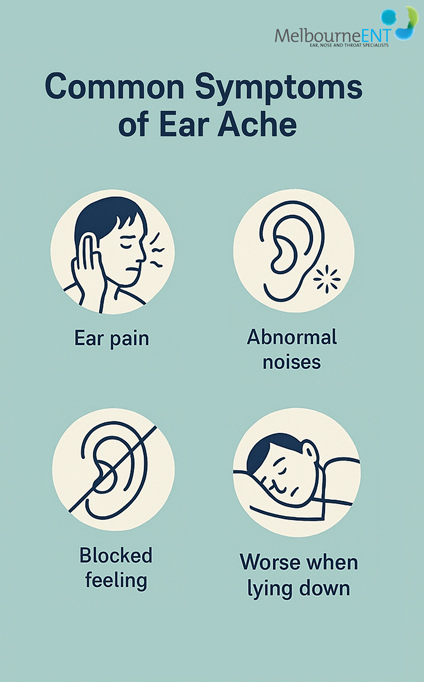
Common Symptoms of Ear Ache
Symptoms of ear ache vary depending on the cause. They may include discomfort within or around the ear that intensifies when lying down, during swallowing, or with jaw movement. Pain might start suddenly or gradually increase over time, often accompanied by other distressing sensations such as a blocked or popping feeling, reduced auditory perception, and the presence of abnormal ear noises.
In addition to ear-specific symptoms like discharge or hearing reduction, associated features such as fever, facial discomfort, sore throat, or a general sense of malaise may be present. These symptoms can indicate the systemic spread of an infection or suggest that the source of the pain may lie outside the ear itself. Such complexities highlight the importance of a comprehensive ENT evaluation to accurately determine the origin and extent of the condition.
Who is Affected by Ear Ache?
Ear aches can affect individuals across all age groups, though certain populations are more vulnerable. Children are particularly susceptible due to anatomical and physiological factors, including shorter and more horizontal Eustachian tubes which can become easily blocked or infected. This often leads to recurring middle ear infections, particularly following upper respiratory illnesses.
Adults engaged in frequent water activities or those with underlying allergic rhinitis or sinus conditions may also be predisposed to ear pain. In these groups, outer ear infections and pressure imbalances are common. Travellers and aviation professionals frequently experience discomfort due to barotrauma resulting from rapid changes in altitude.
Additionally, elderly individuals may encounter ear ache stemming from chronic wax accumulation, age-related hearing loss complications, or even referred pain from dental or temporomandibular joint disorders.
Diagnosis and Evaluation at Melbourne ENT
Our thorough diagnostic process ensures we uncover the underlying cause of your ear ache. Steps include an in-depth review of your symptoms, lifestyle factors, and medical history to identify patterns or potential environmental triggers. We perform a physical examination using both handheld otoscopy and advanced binocular microscopy to inspect the ear canal and eardrum in detail, allowing us to detect subtle signs of inflammation, infection, or trauma.
Audiological assessments are conducted when there is any indication of hearing involvement. These include pure tone audiometry to gauge hearing sensitivity and tympanometry to evaluate middle ear pressure and Eustachian tube function. For cases where ear ache may be referred from nearby structures, nasal or laryngeal endoscopy is performed to assess for sinus disease, throat infection, or laryngeal irritation.
Imaging studies such as CT or MRI scans may be recommended in cases of chronic infections, suspected cholesteatoma, unclear diagnosis or when surgical intervention is considered. Each step of the evaluation is designed to provide clarity, guide treatment decisions, and reassure patients.
Treatment Options for Ear Ache
Treatment is customised based on the underlying cause. Options include a range of medical therapies, minimally invasive procedures, and in some cases, surgical intervention. For outer ear infections, topical ear drops are typically effective, often leading to rapid symptom resolution. Middle ear infections, especially those associated with fever or fluid accumulation, may require oral antibiotics and close monitoring to ensure full recovery.
Pain management is an essential component of treatment, with anti-inflammatory medications providing relief and improving comfort during recovery. Where allergies or sinus issues contribute to Eustachian tube dysfunction, nasal sprays, antihistamines, and steam inhalation may be used to relieve congestion and restore pressure balance.
Surgical interventions are considered when conservative treatments fail or in recurrent, complex cases. Grommet insertion helps ventilate the middle ear and is particularly effective in children with chronic otitis media. Myringotomy allows for drainage of fluid in acute or recurrent infections. In more advanced cases, surgical removal of cholesteatoma or mastoid infection may be required, procedures which our surgeons perform with precision and care. All surgery has risks and you should consult an appropriately qualified professional for a second opinion.
When is Surgery Recommended?
Surgery may be necessary when recurrent or chronic ear infections persist despite medical treatment. Repeated infections can lead to fluid retention in the middle ear, affecting hearing and potentially impacting speech development in children. In such scenarios, grommet insertion is a simple yet effective solution, allowing air to enter the middle ear and preventing fluid build-up.
Other indications for surgery include structural abnormalities like a perforated eardrum, persistent negative ear pressure, or the presence of cholesteatoma, a non-cancerous but locally destructive skin growth. These conditions can lead to progressive hearing loss, balance problems, and even facial nerve involvement if not addressed promptly.
Our experienced surgeons assess each patient holistically, considering their symptoms, lifestyle, and preferences to recommend the most appropriate surgical approach.
Recovery and Prognosis
Recovery times vary depending on the treatment administered. Medical therapies often provide relief within a few days, with complete resolution in about a week. Surgical procedures such as grommet insertion are typically performed as day surgeries, allowing patients to return home the same day with minimal downtime.
Following surgery, patients are given clear postoperative instructions including activity limitations, medication schedules, and signs to watch for. Follow-up visits ensure the healing process is on track and that any issues are promptly addressed.
Hearing tests may be repeated to document improvement or monitor ongoing conditions. With proper care, most patients achieve full recovery and regain normal ear function, contributing to a significantly improved quality of life.
Risks or Complications if Left Untreated
Untreated ear ache can lead to serious complications. Prolonged infections may result in chronic hearing loss, especially in children, potentially affecting speech and learning. Infections that spread beyond the ear can lead to mastoiditis, an infection of the mastoid bone, or even more severe conditions such as meningitis or brain abscess in rare cases.
Persistent fluid in the middle ear can cause a conductive hearing loss and interfere with daily activities, communication, and concentration. Cholesteatoma, if undiagnosed and untreated, may erode bone, damage nearby nerves, and lead to long-term disability.
Ignoring referred ear pain can also delay diagnosis of more serious conditions like throat cancer or dental abscesses. Early intervention at Melbourne ENT ensures accurate diagnosis and prompt, effective management, minimising these possible risks.
FAQs About Ear Ache
Can ear ache be caused by stress or jaw tension?
Yes, stress-related tension or disorders of the temporomandibular joint (TMJ) can result in referred ear pain. Clenching or grinding teeth can irritate nearby nerves, causing discomfort that feels like it’s coming from the ear.
Why does my ear ache only at night or when lying down?
Ear pain can intensify at night due to pressure changes in the middle ear when lying flat. Fluid buildup or inflammation may worsen when the head is not elevated, leading to greater discomfort during rest.
Is ear ache always a sign of infection?
Not always. While infections are common causes, ear ache can also result from, barometric pressure changes, dental problems, or even nerve-related conditions. A proper ENT assessment is essential for accurate diagnosis.
Why does cold weather make my ears hurt?
Exposure to cold wind or sudden temperature drops can cause vasoconstriction and nerve sensitivity in the outer ear. In individuals with underlying ear or sinus conditions, this sensitivity can trigger or worsen ear ache.
Can allergies really cause ear ache?
Yes. Allergies can lead to nasal congestion and Eustachian tube dysfunction, which affects pressure regulation in the middle ear. This imbalance can result in discomfort or a sensation of fullness and pain in the ears.
Why does my ear hurt when I chew or yawn?
Pain during jaw movement may indicate TMJ disorder, inflammation of the jaw joint, or pressure imbalances in the Eustachian tube. These symptoms should be evaluated, especially if persistent.
Can ear ache be related to neck problems?
Yes. Cervical spine issues or muscle tension in the neck and upper back can cause referred pain to the ear due to shared nerve pathways. This type of ear ache may feel deep and persistent without obvious ear findings
Sources:
- Ear Infection (Otitis Media): Symptoms, Causes & Treatment – Cleveland Clinic
https://my.clevelandclinic.org/health/diseases/8613-ear-infection-otitis-media - Ear infection (middle ear) – Symptoms & causes – Mayo Clinic
https://www.mayoclinic.org/diseases-conditions/ear-infections/symptoms-causes/syc-20351616 - Ear infection (middle ear) – Diagnosis & treatment – Mayo Clinic
https://www.mayoclinic.org/diseases-conditions/ear-infections/diagnosis-treatment/drc-20351622 - Common ear infection questions – Mayo Clinic Health System
https://www.mayoclinichealthsystem.org/hometown-health/speaking-of-health/questions-about-earaches-and-ear-infections - Treat ear infections with antibiotics? – Mayo Clinic Health System
https://www.mayoclinichealthsystem.org/hometown-health/speaking-of-health/do-ear-infections-always-need-to-be-treated-with-antibiotics - Ear infection (middle ear) – Mayo Clinic Care Network / University of Kansas Health System
https://www.kuh.ku.edu.tr/mayo-clinic-care-network/mayo-clinic-health-information-library/diseases-conditions/ear-infection-middle-ear - Ear infection (middle ear) – Swiss Medical Network (Mayo Clinic Health Library)
https://www.swissmedical.net/it/healtcare-library/con-20164000
Concerned About Ear Ache?
If you’re experiencing ear pain or related symptoms, don’t wait. Book a consultation with Melbourne ENT for experienced diagnosis and personalised care. We understand the discomfort and anxiety that ear problems can cause and are committed to helping you find lasting relief. Our clinic is equipped to provide rapid access to specialists, thorough assessments, and a full range of treatment options.
Whether you’re dealing with a minor irritation or a complex, persistent issue, we are here to support you every step of the way. Trust your care to Melbourne ENT and benefit from the experience, expertise, and dedication of our surgical team. Call (03) 9038 1311 or contact us.
Our team is here to help you find relief and get back to living comfortably.
Further Reading
- Read about Melbourne ENT’s Surgery for Ear Tubes in Melbourne
- Read about Melbourne ENT’s Otoplasty Melbourne – Ear Surgery
- Read about Melbourne ENT’s Sudden Hearing Loss – An Otologic Emergency In Melbourne
- Read about Melbourne ENT’s Middle Ear Infection (AOM)
Why Choose Dr Kleid ?

Dr Stephen Kleid,
Melbourne ENT Surgeon
MED0001052799
Dr Stephen Kleid is an experienced ENT Surgeon (Otolaryngologist) based in Melbourne with a passion for Septo-rhinoplasty, Septoplasty and a strong interest in Rhinoplasty Revision.
Qualifications
- AHPRA (Medical Board)
- MB, BS; FRACS (Fellow of the Royal Australasian College of Surgeons)
- AAFPS – Member of the Australasian Academy of Facial Plastic Surgery
- AAFPRS – (International Member of the American Academy of Facial Plastic and Reconstructive Surgeons)
Dr Kleid’s Procedures
Why Choose Dr Braham ?

Dr Simon Braham,
Melbourne ENT Surgeon
MED0001144757
Dr Simon Braham MBBS (Hons) FRACS is an experienced Ear, Nose and Throat ENT Surgeon (Otolaryngologist) based in Melbourne, performing tonsil, grommet and sinus surgery for children & adults. He helps patients with breathing issues, snoring concerns and sleep disturbances.
Dr Braham’s Procedures
How can we help?
The Melbourne ENT Team takes pleasure in assisting you with any questions when considering a plastic surgery procedure. Please call the St Kilda East clinic in Melbourne between 9am – 5 pm on Weekdays.
What Next?

Want more information about your Procedure?
- Please read our website and blogs to find out more about your procedure and concerns
- For more information about pricing and payment methods, please visit our page on Surgery Payment Options.
- Talk to our Patient Care Team from 9 am to 5 pm Monday to Friday

What to Bring to Your Consultation
- We encourage you to bring a friend or family member to accompany you, as they can provide an extra perspective and support throughout the process.
- It is important to take thorough notes and carefully review all the documents provided to you.

How to Book a Consultation
- A referral from your GP or Specialist is necessary to see a surgeon for a consultation.
- Check the guide to consultation fees and payment for Melbourne ENT plastic surgeons.
- Please contact us to book your consultation.