

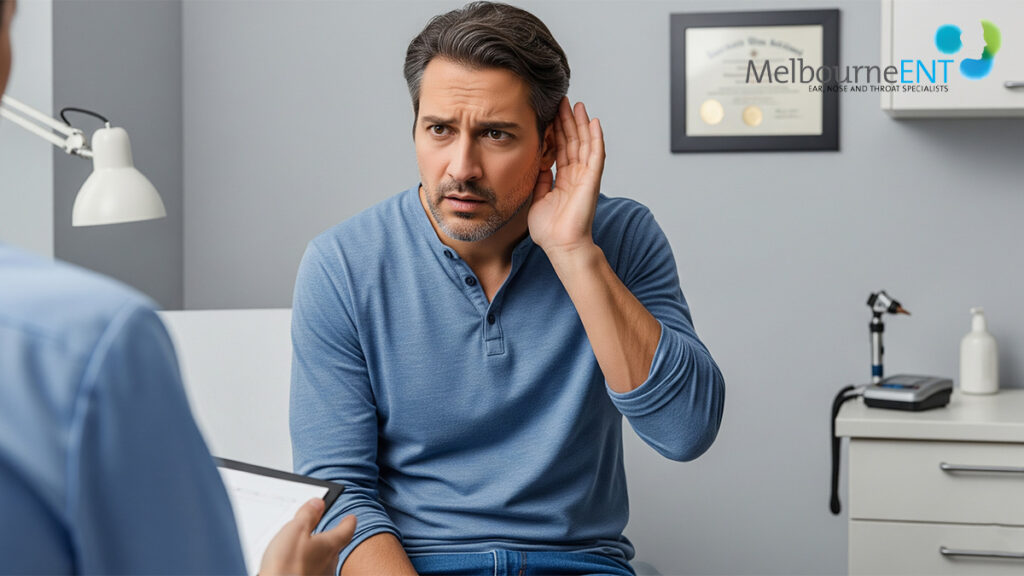
At Melbourne ENT, situated in St Kilda East, our experienced surgeons Dr Stephen Kleid and Dr Simon Braham offer comprehensive care for a wide range of ENT conditions. Among the most time-sensitive of these is sudden hearing loss, a potentially reversible emergency that demands prompt expert assessment. Our clinic combines decades of surgical experience, advanced diagnostics, and patient-first care to provide effective solutions for this urgent concern.
Whether you are experiencing symptoms for the first time or have had a previous episode, our clinic is equipped to provide timely, evidence-based treatment with compassion and expertise.
What Is Sudden Hearing Loss?
Sudden Sensorineural Hearing Loss (SSNHL) refers to an abrupt, unexplained loss of hearing-most often in one ear-occurring over a short period of up to 72 hours. It is typically identified when a patient wakes up and notices a significant change in hearing ability, or during a sudden moment in the day.
This type of hearing loss impacts the inner ear (cochlea) or the auditory nerve and differs from conductive hearing loss caused by obstructions such as wax or fluid. The affected ear may feel as though it is under water, with everyday sounds becoming faint or distorted.
The condition is considered a medical emergency, and early diagnosis and treatment significantly increase the chance of hearing recovery. SSNHL may be temporary or permanent, and without prompt intervention, the risk of irreversible damage increases. The condition can sometimes mimic benign issues like earwax buildup, but it is essential to seek a professional evaluation immediately to rule out serious causes and initiate appropriate care.
Common Symptoms Of Sudden Hearing Loss
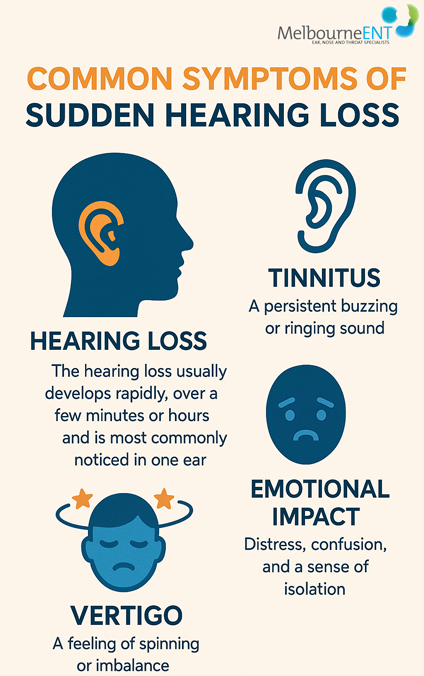
Patients often report a sudden change in auditory perception, which may occur upon waking or during the course of regular activities. The hearing loss usually develops rapidly, over a few minutes or hours, and is most commonly noticed in one ear. Alongside this, patients may also experience a persistent buzzing or ringing sound that can range from a mild hum to a high-pitched whine. This condition, known as tinnitus, often accompanies SSNHL and may persist even after hearing improves.
Vertigo is another alarming symptom that may accompany SSNHL. It may present as a feeling of spinning or imbalance, making daily activities such as walking or driving difficult. When vertigo occurs with hearing loss, it typically points to inner ear involvement and must be assessed urgently.
The emotional impact of these symptoms can be profound, often causing distress, confusion, and a sense of isolation as patients struggle to understand the cause of their sudden sensory loss.
Who Is Affected By Sudden Hearing Loss?
Sudden hearing loss can affect individuals of all backgrounds and health statuses. While it is most commonly seen in adults between the ages of 30 and 60, cases in children and older adults are not uncommon.
This condition does not discriminate based on gender, and it may occur even in individuals with no prior ear problems or health conditions. In many instances, patients are otherwise healthy and active, making the sudden onset particularly shocking.
Environmental and lifestyle factors can increase susceptibility. Exposure to high levels of noise, certain medications known to be ototoxic, recent viral infections, and autoimmune diseases all play a role. Those with underlying vascular conditions or chronic health issues such as diabetes or hypertension may also be at increased risk. Nevertheless, a substantial number of cases arise without any clear cause, highlighting the unpredictable nature of SSNHL.
Diagnosis And Evaluation At Melbourne ENT
Early and accurate diagnosis improves outcomes significantly. At Melbourne ENT, we follow a structured, multi-tiered approach to evaluating sudden hearing loss. During your first visit, our specialists will conduct a detailed review of your medical history and symptoms. We will perform a visual inspection of your ear using an otoscope to assess for any visible causes such as infection or foreign objects.
Hearing tests are central to our evaluation process. A pure-tone audiogram helps us determine the degree and type of hearing loss across various frequencies, while speech discrimination tests assess how clearly words are heard. Tympanometry is also used to evaluate the pressure and function within the middle ear, helping to differentiate between sensorineural and conductive loss.
In some cases, we may recommend advanced imaging, such as an MRI, to investigate the presence of rare conditions like tumours on the auditory nerve. Blood tests may also be ordered if systemic issues such as autoimmune disorders or infections are suspected.
Treatment Options For Sudden Hearing Loss
The urgency of treatment cannot be overstated. Intervention within the first 7 days from the onset of symptoms offers the best chance for recovery. Our approach is tailored to each patient and considers the severity, underlying cause, and accompanying symptoms.
High-dose oral corticosteroids, such as prednisolone, are the first-line treatment and are typically administered over a 10-14 day course. These medications help reduce inflammation in the cochlea and protect auditory nerve function.
For patients who cannot tolerate oral steroids or in whom oral therapy proves ineffective, intratympanic steroid injections offer a targeted solution by delivering medication directly to the inner ear. This is typically administered through a grommet tube (direct reader to grommet surgery)
Depending on the suspected cause, additional treatments may be employed. These could include antiviral medications if a viral infection is implicated or hyperbaric oxygen. In cases of persistent hearing loss, rehabilitation options such as hearing aids or cochlear implants may be discussed.
We also provide support for managing associated conditions like tinnitus through sound therapy, counselling, and tinnitus retraining. Balance issues can be addressed through vestibular physiotherapy or tailored exercises under professional supervision.
When Is Surgery Recommended?
Surgical intervention is not a common requirement for sudden hearing loss but may be essential in select scenarios to apply the steroids topically to the cochlea typically through a grommet tube
In patients with irreversible, profound hearing loss who do not benefit from hearing aids, cochlear implantation may be considered. This advanced procedure involves the placement of a small electronic device that stimulates the auditory nerve, providing a sense of sound to those with severe inner ear damage.
Our team works closely with audiologists and hearing rehabilitation specialists to ensure the best surgical outcomes and post-operative support.
Recovery And Prognosis
Recovery outcomes vary greatly between individuals and are influenced by the speed of diagnosis, the severity of the initial hearing loss, and the presence of symptoms such as vertigo. Prompt treatment increases the chances of significant recovery, and in most cases, patients may experience a near-complete return to normal hearing. For others, residual symptoms such as partial hearing loss or tinnitus may remain.
The first few weeks are critical, as most improvements are observed within 14 to 21 days. However, some patients may continue to recover over several months. Long-term rehabilitation and follow-up care are essential in these cases.
Our team at Melbourne ENT ensures that patients receive ongoing monitoring, including repeat audiograms and counselling to support both hearing recovery and emotional well-being. Lifestyle changes, such as reducing noise exposure, sleep, good nutrition and managing chronic health conditions, can also contribute to long-term ear health.
Risks Or Complications If Left Untreated
Delaying medical attention for sudden hearing loss can result in irreversible consequences. Permanent hearing impairment is the most significant risk, which may lead to difficulties in communication, especially in noisy environments or group settings. This can contribute to social withdrawal, reduced job performance, and strain on personal relationships.
Tinnitus, a common co-symptom, can become chronic and intrusive, severely affecting quality of life. Balance disorders associated with untreated inner ear problems may increase the risk of falls, particularly in older adults. Furthermore, untreated hearing loss has been linked to cognitive decline, memory issues, and a higher risk of developing dementia in later life. Seeking early intervention at Melbourne ENT helps mitigate these risks and supports better long-term outcomes.
Concerned About Sudden Hearing Loss?
Sudden hearing loss can be frightening, but you’re not alone, and help is available. At Melbourne ENT, we understand the anxiety and uncertainty that come with abrupt changes in hearing. Our clinic offers expedited appointments to ensure that patients with acute symptoms are seen as quickly as possible. Whether it’s your first episode or a recurrence, we are here to guide you through every step of the evaluation and treatment process. You can speak with our reception team directly to secure a priority appointment with one of our specialists.
Dr Stephen Kleid can be reached on (03) 9038 1630 or through his website. Dr Simon Braham is available at (03) 9038 1311, and more information about his services can be found at his website. Our team understands the urgency and is prepared to support you with prompt, compassionate, and expert ENT care.
FAQs About Sudden Hearing Loss
Can sudden hearing loss happen more than once?
Yes, while rare, some patients may experience multiple episodes of sudden hearing loss. Recurrence can sometimes indicate an underlying autoimmune or vascular condition that needs further evaluation.
Is it possible to mistake sudden hearing loss for something like an ear infection or wax blockage?
Absolutely. Many patients initially assume it’s something minor. This is why professional evaluation is critical-delaying treatment can reduce the chances of recovery.
Does stress or fatigue play a role in triggering sudden hearing loss?
There is growing evidence that extreme stress and fatigue may contribute to circulatory or immune disturbances that could trigger SSNHL in predisposed individuals.
What does recovery feel like-does hearing return all at once or gradually?
Recovery patterns vary. Some patients experience a sudden improvement, while others regain hearing gradually over weeks or even months. Follow-up testing helps monitor this.
If my hearing returns, can I go back to normal activities immediately?
Generally, yes-but patients are advised to avoid loud environments initially and follow hearing protection guidelines to preserve inner ear health.
Can tinnitus from sudden hearing loss go away even if hearing doesn’t improve?
Yes. Tinnitus can sometimes fade over time, even in cases where the hearing loss remains. Therapy and sound management techniques can also help significantly.
What should I do if I notice sudden hearing loss during the weekend or after hours?
Seek medical attention immediately at an emergency department or urgent care. The sooner treatment begins, the better the outcome-even if it means starting with a general practitioner or emergency clinician.
Sources:
- Global trends and hotspots in research for sudden hearing loss over the past 20 years
https://pmc.ncbi.nlm.nih.gov/articles/PMC12129775/ - Onset of sudden sensorineural hearing loss: An update – Royal Australian College of General Practitioners
https://www1.racgp.org.au/ajgp/2025/july/onset-of-sudden-sensorineural-hearing-loss - Efficacy and fibrinogen correlations of defibrinogen therapy in idiopathic sudden sensorineural hearing loss
https://www.nature.com/articles/s41598-024-84723-3 - Sudden sensorineural hearing loss – Canadian Medical Association Journal (CMAJ)
https://www.cmaj.ca/content/197/3/E68 - Current Role of the Nonsteroid Treatment of Idiopathic Sudden Hearing Loss
https://www.mdpi.com/2077-0383/14/8/2811 - Role of hyperbaric oxygen therapy in idiopathic sudden sensorineural hearing loss
https://www.sciencedirect.com/science/article/abs/pii/S0377123725000085 - Hearing Loss – StatPearls – National Center for Biotechnology Information (NCBI) Bookshelf
https://www.ncbi.nlm.nih.gov/books/NBK542323/
Why Choose Melbourne ENT?
Melbourne ENT is not just another ENT clinic. We are a specialist-led team offering patient-centred care, surgical precision, and long-term support. We believe that every patient deserves to feel heard, understood, and empowered throughout their medical journey. Our dedicated staff ensure that every visit is informative, reassuring, and tailored to your individual needs.
Dr Stephen Kleid
Dr Kleid is a senior ENT and Head & Neck Surgeon with over four decades of experience. He has a particular interest in cochlear implants, complex ear surgery, and the management of head and neck tumours. He is a former department head at Royal Melbourne Hospital and has mentored generations of ENT surgeons. His approach combines academic rigour with patient compassion, ensuring that every treatment plan is evidence-based and outcome-driven.
Dr Simon Braham
Dr Braham is a dual-trained ENT surgeon who brings refined skill and aesthetic insight to every procedure. His practice spans paediatric ENT, nasal and sinus surgery, and complex facial procedures. He holds appointments at the Royal Victorian Eye and Ear Hospital and Masada Private Hospital and is known for his calm demeanour and patient-first approach.
“Our goal is simple – restore hearing, relieve fear, and help patients regain confidence.” – Dr Stephen Kleid & Dr Simon Braham
You deserve expert care. Trust Melbourne ENT to help you hear clearly again.
Further Reading
- Read about Melbourne ENT’s Ear Concern
- Read about Melbourne ENT’s Grommets Surgery Melbourne
- Read about Melbourne ENT’s Surgery for Ear Tubes in Melbourne
- Read about Melbourne ENT’s Ear Procedures Medicare Item Numbers
- Read about Melbourne ENT’s Glue Ear (Grommets)
- Read about Melbourne ENT’s Ear Ache
Why Choose Dr Kleid ?

Dr Stephen Kleid,
Melbourne ENT Surgeon
MED0001052799
Dr Stephen Kleid is an experienced ENT Surgeon (Otolaryngologist) based in Melbourne with a passion for Septo-rhinoplasty, Septoplasty and a strong interest in Rhinoplasty Revision.
Qualifications
- AHPRA (Medical Board)
- MB, BS; FRACS (Fellow of the Royal Australasian College of Surgeons)
- AAFPS – Member of the Australasian Academy of Facial Plastic Surgery
- AAFPRS – (International Member of the American Academy of Facial Plastic and Reconstructive Surgeons)
Dr Kleid’s Procedures
Why Choose Dr Braham ?

Dr Simon Braham,
Melbourne ENT Surgeon
MED0001144757
Dr Simon Braham MBBS (Hons) FRACS is an experienced Ear, Nose and Throat ENT Surgeon (Otolaryngologist) based in Melbourne, performing tonsil, grommet and sinus surgery for children & adults. He helps patients with breathing issues, snoring concerns and sleep disturbances.
Dr Braham’s Procedures
How can we help?
The Melbourne ENT Team takes pleasure in assisting you with any questions when considering a plastic surgery procedure. Please call the St Kilda East clinic in Melbourne between 9am – 5 pm on Weekdays.
What Next?

Want more information about your Procedure?
- Please read our website and blogs to find out more about your procedure and concerns
- For more information about pricing and payment methods, please visit our page on Surgery Payment Options.
- Talk to our Patient Care Team from 9 am to 5 pm Monday to Friday

What to Bring to Your Consultation
- We encourage you to bring a friend or family member to accompany you, as they can provide an extra perspective and support throughout the process.
- It is important to take thorough notes and carefully review all the documents provided to you.

How to Book a Consultation
- A referral from your GP or Specialist is necessary to see a surgeon for a consultation.
- Check the guide to consultation fees and payment for Melbourne ENT plastic surgeons.
- Please contact us to book your consultation.