


At Melbourne ENT, based in St Kilda East, our dedicated team led by ENT and Head & Neck Surgeons Dr Stephen Kleid and Dr Simon Braham offers specialist care for a wide spectrum of nasal, sinus, and ENT concerns. One common yet often distressing complaint we address is the loss of smell. Our comprehensive, patient-centred approach ensures accurate diagnosis, tailored treatment, and long-term support. With our expertise and compassionate care, we aim to restore not just your sense of smell, but also your overall quality of life and well-being.
What Is Loss Of Smell?
Loss of smell, also known as anosmia, refers to the partial or complete inability to detect odours in your environment. It can have a profound and often underestimated impact on daily living, influencing not only how we experience food and drink but also our personal safety, such as recognising smoke from a fire or detecting gas leaks. The olfactory system is closely linked with the brain’s limbic system, which governs memory and emotions, so anosmia may also affect mood and cognitive functions.
Loss of smell may be temporary, often associated with common respiratory infections like colds, flu, or more recently, COVID-19. In some cases, it can be persistent or even permanent, especially when it results from anatomical obstructions in the nasal passages, head trauma, or chronic inflammatory conditions. Left untreated, anosmia can significantly reduce quality of life.
Common Symptoms Of Loss Of Smell
Patients may report a complete inability to perceive odours, known as total anosmia, or a noticeable reduction in olfactory sensitivity, referred to as hyposmia. Others may experience distorted smells where familiar scents are altered or unpleasant, a condition known as parosmia, or phantom smells without any real source, known as phantosmia. These symptoms may occur alone or alongside nasal issues like congestion, sinus pressure, postnasal drip, or frequent sinus infections. Individuals may also report diminished taste, as flavour perception is closely linked to the sense of smell.
Who Is Affected By Loss Of Smell?
Loss of smell can affect individuals across all age groups, although it is more prevalent among older adults due to the natural decline in olfactory nerve function. People recovering from upper respiratory tract infections, especially COVID-19, are commonly affected, and some may experience prolonged or even chronic anosmia. Those with chronic nasal inflammation, nasal polyps, allergic rhinitis, or chronic sinusitis are also at higher risk.
Head trauma, particularly involving the frontal lobe or olfactory nerve pathways, may result in anosmia. Additionally, individuals with certain neurological conditions like Parkinson’s or Alzheimer’s disease often experience smell loss as an early symptom. Smoking, prolonged exposure to industrial chemicals, or air pollutants can also damage the olfactory system over time, contributing to a gradual reduction in smell sensitivity. Loss of sense of smell is either sinus related or neurological in aetiology. At Melbourne ENT we will delineate which and treat any sinus causes.
Diagnosis And Evaluation At Melbourne ENT
When you visit Melbourne ENT, our thorough diagnostic process begins with an in-depth medical history and discussion of your symptoms, followed by a comprehensive nasal examination. Our specialists use advanced endoscopic techniques to visually inspect the nasal cavity and olfactory cleft for any obstructions, polyps, or inflammation that may be impairing your sense of smell.
Depending on your symptoms and findings, we may conduct objective olfactory tests to quantify the degree of smell loss. In some cases, imaging such as CT or MRI scans may be recommended to identify underlying structural abnormalities, sinus disease, or neurological causes. Our clinic is equipped with the latest diagnostic tools to ensure a precise and efficient evaluation.
Treatment Options For Loss Of Smell
At Melbourne ENT, treatment strategies for loss of smell are tailored to the root cause of the condition. If the anosmia is due to inflammation, allergies, or infection, medical therapies are usually the first line of treatment. These may include corticosteroid nasal sprays to reduce swelling, antihistamines to manage allergic responses, or decongestants to improve airflow. Saline rinses may also help to clear irritants and mucus, supporting recovery.
In cases where conservative treatments are insufficient or when physical obstruction is diagnosed, surgical intervention may be required. Septoplasty can be performed to correct a deviated septum that blocks airflow to the olfactory area. Turbinoplasty is used to reduce hypertrophied turbinates that can restrict nasal passageways. Functional endoscopic sinus surgery (FESS) is another option, particularly for those with chronic sinusitis or nasal polyps that contribute to anosmia. Our goal is always to restore as much olfactory function as possible with the least disruption to the patient’s overall nasal structure and function. Neurological causes will be managed by a neurologist.
When Is Surgery Recommended?
Surgical treatment is considered when non-surgical therapies have not provided adequate relief, and there is a clear sinus cause contributing to the loss of smell. Patients who experience chronic nasal obstruction from polyps, a severely deviated septum, or turbinate hypertrophy that prevents air from reaching the olfactory receptors are likely candidates for surgery. Chronic sinus infections that fail to respond to antibiotics or anti-inflammatory medications may also necessitate surgical intervention.
Dr Kleid and Dr Braham take a highly individualised approach to each patient, thoroughly explaining the rationale for surgery, expected outcomes, and recovery timelines. Their expertise in functional and cosmetic nasal procedures ensures that structural improvements also consider the aesthetic outcome, preserving or enhancing the natural appearance of the nose while addressing the underlying problem.
Recovery And Prognosis
Recovery following treatment for loss of smell varies based on the chosen intervention and the patient’s overall health. For non-surgical therapies, improvement may be seen within a few weeks, although full recovery may take months, especially if smell retraining therapy is required. Smell training involves repeated, mindful exposure to a set of distinct scents over time, helping the brain rebuild olfactory pathways.
Following nasal or sinus surgery, patients typically begin to notice improvements in nasal breathing within the first few weeks. It may take several months for olfactory function to fully stabilise, especially in cases where the olfactory nerve has been affected by chronic inflammation. Postoperative care includes nasal irrigation, medication management, and follow-up visits to monitor healing and prevent recurrence of the condition.
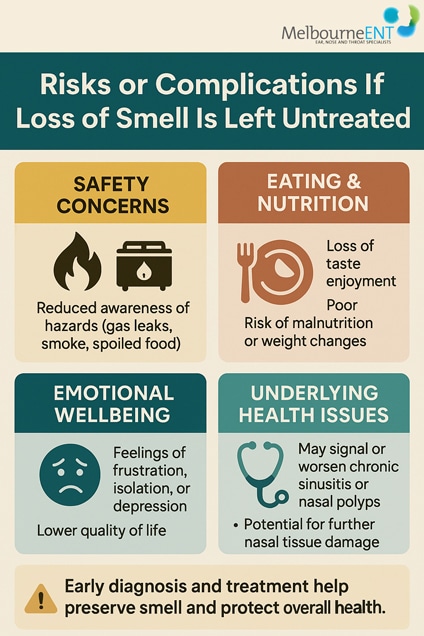
Risks Or Complications If Left Untreated
If left untreated, loss of smell can lead to significant lifestyle challenges. Individuals may become less aware of environmental dangers, such as spoiled food, gas leaks, or smoke. Anosmia can also diminish the pleasure associated with eating and drinking, potentially leading to poor appetite, nutritional deficiencies, or weight fluctuations.
Furthermore, the inability to smell can impact emotional wellbeing, often contributing to feelings of isolation, frustration, or depression. In cases related to chronic sinusitis or polyps, ignoring symptoms may allow the underlying disease to progress, resulting in further damage to the nasal tissues and potentially more complex treatment needs in the future. Early intervention is key to preserving olfactory function and overall health.
Why Choose Your Surgeon
Dr Stephen Kleid is a distinguished ENT and Head & Neck Surgeon with decades of experience treating complex nasal and sinus disorders. His career includes senior positions at leading institutions such as Peter MacCallum Cancer Centre and Royal Melbourne Hospital. Dr Kleid is also involved in ongoing research, teaching, and the development of surgical techniques aimed at improving patient outcomes in rhinology.
Dr Simon Braham complements the team with his extensive experience in ENT surgery and additional training in cosmetic and reconstructive techniques. His background includes advanced training in both Australia and the United States, with a focus on achieving harmonious outcomes that consider both function and aesthetics. He brings a refined approach to nasal surgery, ensuring each patient receives care that is not only medically effective but also cosmetically sensitive.
Together, they offer a collaborative, holistic approach to care that is rooted in medical excellence and genuine concern for the wellbeing of every patient. Their practice philosophy places emphasis on clear communication, realistic expectations, and a commitment to achieving the best possible outcomes.
FAQs About Loss Of Smell
What does it mean if I can smell some things but not others?
This often indicates partial damage or obstruction in the olfactory pathways. Some scent molecules may still reach the receptors while others cannot, depending on their size and route through the nasal cavity.
Can smell loss be an early sign of something more serious?
Yes, in some cases it can be an early indicator of neurological conditions such as Parkinson’s or Alzheimer’s disease. If loss of smell is unexplained or persists, further evaluation is important.
Why does my sense of smell return temporarily and then disappear again?
Fluctuations in smell often occur when inflammation or congestion varies. For example, your sense of smell may improve after a shower or nasal rinse but diminish again when swelling returns.
How does smell training actually help retrain the brain?
Smell training uses repeated exposure to specific scents to stimulate the olfactory system and encourage regeneration of nerve pathways. Over time, this can help the brain recognise and interpret smells more effectively.
Are there long-term changes in the brain associated with smell loss?
Prolonged anosmia can lead to changes in areas of the brain responsible for memory and emotion. This is why some patients also experience mood shifts or cognitive changes alongside smell loss.
Could my loss of smell be caused by something other than nasal issues?
Yes. While many cases are linked to nasal blockages or inflammation, issues affecting the olfactory nerve or brain, including trauma or neurodegenerative diseases, can also lead to smell dysfunction.
Is it possible for smell to come back years after losing it?
Yes, though less common, recovery can happen even after a long period. Success depends on the underlying cause and whether the olfactory system can regenerate or be retrained with therapy.
Sources:
- Long-Term Taste and Smell Outcomes After COVID-19
https://jamanetwork.com/journals/jamanetworkopen/fullarticle/2817869 - Living and Coping with Olfactory and Taste Disorders: A Qualitative Study among Survivors of COVID-19
https://www.ncbi.nlm.nih.gov/pmc/articles/PMC11011467/ - Long-term smell loss experiences after COVID-19: A qualitative study
https://www.ncbi.nlm.nih.gov/pmc/articles/PMC10945215/ - How We Lose Our Sense of Smell, and How It’s Treated
https://stanmed.stanford.edu/sense-smell-health/ - Loss of Smell Treatment | Ohio State Health & Discovery
https://health.osu.edu/discovery-and-innovation/research-advances/loss-of-smell-treatment - Anosmia (Loss of Smell): Causes & Treatment
https://my.clevelandclinic.org/health/diseases/21859-anosmia-loss-of-sense-of-smell - Smell Loss Linked to 100-plus Diseases in New UC Irvine Study
https://news.uci.edu/2024/10/29/smell-loss-linked-to-100-plus-diseases-in-new-uc-irvine-study/
Concerned About Loss Of Smell?
Don’t let a diminished sense of smell affect your health, safety, or enjoyment of life. Whether you’ve recently noticed a change or have been struggling with this issue for years, help is available. At Melbourne ENT, we are committed to providing compassionate, high-quality care tailored to your specific needs. To schedule a comprehensive consultation, please call Dr Stephen Kleid on (03) 9038 1630 or Dr Simon Braham on (03) 9038 1311. For more information, visit for Dr Kleid. Dr Braham or the Melbourne ENT clinic.
Further Reading
- Read about Melbourne ENT’s Nose Concerns and Conditions
- Read about Melbourne ENT’s Sinusitis Melbourne
- Read about Melbourne ENT’s Sinus Surgery Melbourne
- View Melbourne ENT’s Before and After Photos